Supersonic
- Platform
- Linux macOS Windows
- Licence
- GPL-3.0 Open source
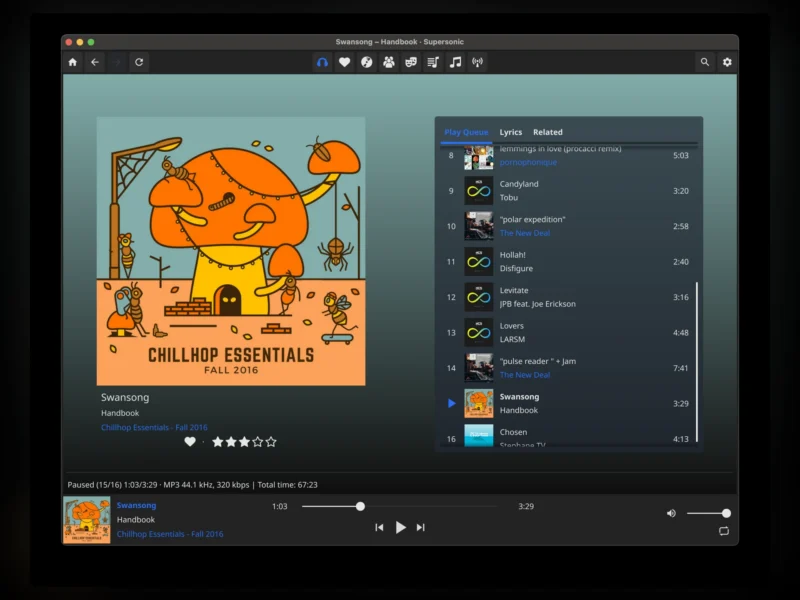
Supersonic is a lightweight desktop client for the music server you already run, written in Go with the Fyne toolkit rather than in a browser wrapper. Point it at Navidrome, Jellyfin or any Subsonic/OpenSubsonic server and you get a native window with an albums grid, an artist view, a now-playing screen and a waveform seekbar, all rendered by the desktop rather than by a Chromium runtime. It plays through MPV, which brings gapless playback and ReplayGain along with it, integrates with the desktop’s own media controls, and is licensed GPL-3.0.
What it does
- Native, lightweight UI – a Go and Fyne interface with infinite scrolling rather than a virtualised web list, available in light and dark themes with optional automatic switching, plus custom themes loaded from files.
- MPV playback – high-quality gapless playback through MPV, an optional audio exclusive mode, ReplayGain where the files on the server are tagged, and a waveform seekbar in place of a plain progress bar.
- Servers and hostnames – add and switch between several servers, each with a primary and an alternate hostname so the same library works from inside the LAN and from outside it.
- Library and tracklist control – album filters, sortable tracklists with configurable visible columns, artist radio built from an artist and their similar artists, and downloads of songs, albums or playlists.
- Audio extras – a built-in 15-band graphic equaliser, internet radio stations on Subsonic servers, and casting to UPnP/DLNA devices.
- Desktop integration – MPRIS on Linux, SMTC on Windows and the Mac media centre for media keys and system controls, with scrobbling back to the server under configurable criteria.
Requirements and deployment
Like every client in this category, Supersonic needs a server before it needs anything else: Navidrome, Jellyfin, or a Subsonic/OpenSubsonic server such as Gonic, LMS, Nextcloud Music, Airsonic-Advanced, Ampache, Funkwhale or Supysonic. On Linux the easy routes are the AppImage with MPV bundled, the Flathub package, or the .tar.xz build, which expects libmpv to be installed on the system first; Windows gets an installer or a standalone zip, and macOS gets a .app bundle or a Homebrew tap. Expect one macOS wrinkle: the app is not notarised, so the quarantine attribute has to be removed with xattr before it will launch. The current release is 0.22.1, published in August 2026, and releases are still numbered below 1.0 even though the feature list reads as complete.
Where it fits
The closest comparison is Feishin: both are desktop clients for the same servers, but Feishin is an Electron application with a web build and a Docker image, while Supersonic stays a small native binary and pays for that with fewer skins and no browser version. Supersonic also wins on the audio side, with gapless MPV playback, ReplayGain, an equaliser and DLNA casting, which is the part a browser-based client cannot do properly. If you have not chosen a server yet, Navidrome is the lightest starting point and Jellyfin is the option to take if you want video from the same box; Ampache and Funkwhale are the other listed Subsonic-compatible servers. If your music is a local folder rather than a server, none of these apply and a library player is the right tool instead.