Lollypop
- Platform
- Linux
- Licence
- GPL-3.0 Open source
- Website
- lollypop.org/
- Source code
- gitlab.gnome.org/World/lollypop
Overview
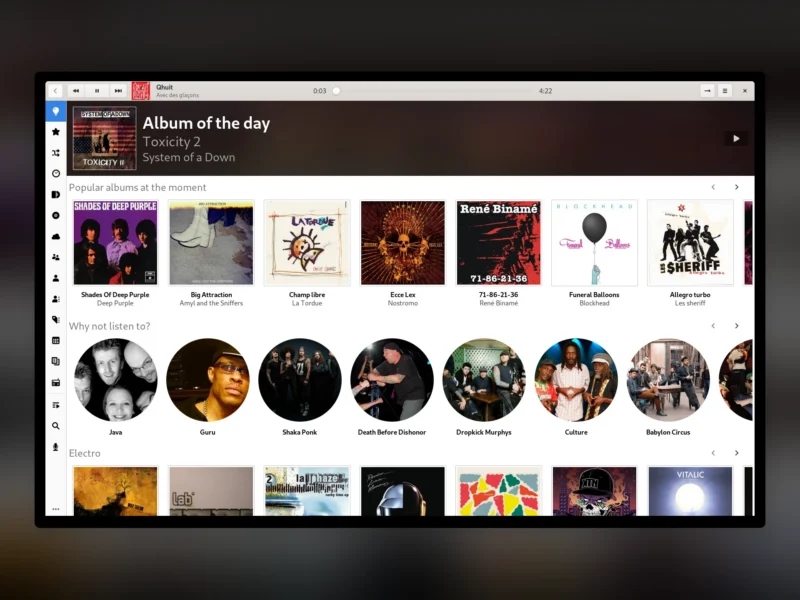
Lollypop is a music player for the GNOME desktop that treats album art as the way into a library: open it and you get a wall of covers, not a file tree. It is written in Python on GTK 3 with libhandy, licensed GPL-3.0, and maintained by Cédric Bellegarde (gnumdk) in the GNOME GitLab; version 1.4.48 shipped on 10 October 2026. It plays the music you already own — MP3, MP4/AAC, Ogg Vorbis and FLAC through GStreamer — indexes your folders into a private SQLite database, and layers the conveniences a desktop player needs on top: a queue, party mode, cover-art fetching, scrobbling and phone sync.
Key Features
- Cover-first browsing — the collection is browsed as grids of album covers, artists and genres, with a search field over the whole library and a track list that keeps the playing album in view.
- Album of the day and discovery rows — the home screen proposes an album of the day, popular albums in your collection and a “Why not listen to?” row of artists you have not played, so a large library does not turn into a library you never touch.
- Play queue and party mode — a main playlist (what other players call the queue) sits beside party mode, which drops the interface to the current playing track and its art.
- Fullscreen player — a full-window view centred on album art, for a second monitor or a TV.
- ReplayGain — tracks are levelled using stored ReplayGain values so a shuffled playlist does not jump in volume between albums.
- Automatic cover-art download — missing artwork is fetched from online providers instead of being left as a grey square, with separate handling for album and artist images.
- Artist context — an artist view that pulls in biography and related-artist information rather than showing only a name and a list of albums.
- Last.fm scrobbling — plays are scrobbled to Last.fm from the client itself, no separate plugin needed.
- TuneIn radio — internet radio stations sit in the same window as local music.
- MTP sync — tracks and albums can be copied to a phone or portable player over MTP from inside the player.
- Codec handling and HiDPI — missing codecs can be installed from the app, and the interface scales properly on high-density screens.
Requirements and Install
Lollypop runs on Linux only. It needs a GTK 3 desktop (GTK 3.20 or newer), libhandy, Python 3 with PyGObject, GStreamer 1.0 with the plugin set for the formats you play, and totem-plparser; building from source uses meson and ninja. The simplest install is the Flatpak from Flathub (flatpak install flathub org.gnome.Lollypop), which bundles the runtime it needs. Debian, Ubuntu, Fedora and Arch users will also find it in the distribution repositories or in the AUR, and the README documents building from Git on Debian/Ubuntu and Fedora.
Who It Is For
A Linux user with a local collection who wants something lighter and more visual than a full media manager: Lollypop is not a tagger, not a library server and not a ripper, but it plays local files, handles radio, syncs to a phone and looks like a native GNOME application while doing it. If the collection already lives in Music or on a mounted NAS share, pointing it at those folders is the whole setup.