Rhythmbox
- Platform
- Linux
- Licence
- GPL-2.0-or-later Open source
- Source code
- gitlab.gnome.org/GNOME/rhythmbox
Overview
Rhythmbox is the music player that belongs to the GNOME desktop: a library-based music management application built on GTK and GStreamer, written in C with a plugin layer that loads extensions written in Python or C. It has been part of GNOME for two decades, and the project notes that it is included in the default installation of several Linux distributions. Its job is wider than playback: it indexes a local collection, subscribes to podcasts, streams internet radio, shares libraries across a network with DAAP, and manages music on portable players.
The current release is 3.5.1, published on 24 August 2026. The 3.5 series moved the player onto a new playback backend and added lyric lookup from lrclib.net, sidecar .lrc files and lyrics embedded in Ogg files, plus a redesigned podcast episode list, reworked podcast notifications and a gPodder.net sync plugin. Rhythmbox is free software under the GNU GPL version 2 or later, with an added permission that allows distribution alongside GStreamer plugins whose licences are not GPL-compatible.
Key Features
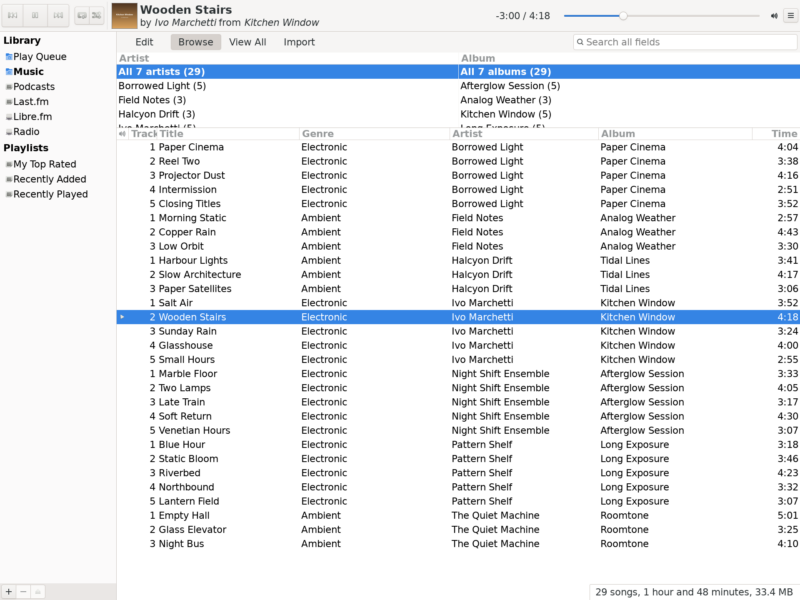
- Library management — watches your music folders, keeps a database of tracks and metadata, and offers full-text search plus the Browse panes for narrowing by artist and album.
- Playlists and smart playlists — ordinary playlists alongside rule-based smart playlists that update themselves, a play queue, and the Recently Added, Recently Played and My Top Rated views.
- Ratings that shape playback — track ratings feed the shuffle algorithm, so highly rated material comes up more often than the rest of the collection.
- Podcasts — subscribe to any feed URL, download new episodes automatically, and see at a glance which episodes have already been played.
- Internet radio — the Radio source keeps a browsable station list from the iradio plugin, so streams sit next to local albums instead of in a separate application.
- DAAP sharing — publish your library on the local network and browse other DAAP libraries from the same sidebar, through the daap plugin and libdmapsharing.
- Portable devices — udev-based detection for iPods, Android phones, MTP devices and generic USB players, with transfer of tracks and playlists.
- Cover art — reads artwork embedded in the tags, falls back to an image file in the album folder, and can search online when neither exists.
- Scrobbling and ReplayGain — submit plays to Last.fm, Libre.fm and ListenBrainz at the same time, and normalise loudness with the ReplayGain plugin.
- Plugin architecture — a documented plugin API for C, Python and Vala; the audio CD, Magnatune store, lyrics, ListenBrainz, web remote, MPRIS and desktop notification features are themselves plugins.
Podcasts, Radio and Sharing
Rhythmbox treats a podcast feed, a radio stream and a shared library as first-class sources rather than separate windows. Subscriptions live in the Podcasts source, new episodes download in the background, and the 3.5 series gives each episode a clear played or unplayed state. Radio stations appear under Radio, and the DAAP plugin turns the same library into something another machine on the LAN can browse. Everything lands in one searchable interface, which is the point: a single place for the music you own and the audio you stream.
Why Use Rhythmbox?
Because it is native. Rhythmbox is a GTK application built on GStreamer, so it fits the GNOME desktop, starts quickly, follows the system theme and needs no bundled browser engine or runtime of its own. It is also old in the best sense: the library database, playlist rules, device handling and podcast downloads have been hardened by two decades of use, and the package is available from the repositories of essentially every major distribution as well as from Flathub as a Flatpak.
It is a good fit if you want one application that covers local playback, podcasts, radio, network sharing and portable players without assembling four separate tools. If you only ever play a folder of files, Rhythmbox is more than you need; if you maintain a large collection and want smart playlists, ratings, scrobbling and device sync, it is close to ideal.
Use Cases
- A GNOME desktop library — the default music application for anyone running GNOME, with artwork, ratings and playlists kept in place.
- Large local collections — smart playlists and Browse panes make a library of thousands of tracks manageable, and ReplayGain keeps the volume steady.
- Podcast listeners — subscribe once, let new episodes download automatically, and see what has already been heard.
- Home network sharing — publish a library over DAAP so other machines on the LAN can play it without copying files.
- Device sync — move albums and playlists to an iPod, an Android phone or a USB player from the same library view.
Getting Started
Install it from your distribution with the package name rhythmbox, or install the Flatpak from Flathub (application ID org.gnome.Rhythmbox3). On first start, point it at your music folder with the Import button and let the library scan finish; the status bar reports the number of songs, total playtime and collection size. Open Edit, then Plugins, to switch on the optional pieces you want, such as DAAP sharing, Last.fm or ListenBrainz scrobbling, the lyrics lookup, ReplayGain or the web remote.
Format support comes from GStreamer, so the codecs you can play are the ones installed on the system. Distributions that split GStreamer plugins into free and restricted packages may need an extra package before MP3 or AAC files play, and a fresh install without codec packages will refuse formats it cannot decode. Rhythmbox is designed for GNOME but runs on other desktops as long as the GTK and GStreamer libraries are present, and it is packaged for Linux as well as for other Unix-like systems through their ports collections.
Alternatives
If you want a Qt-based player with a strong focus on sound quality and library tagging, Strawberry Music Player covers similar ground with high-resolution audio support and a built-in tag editor. Rhythmbox remains the more tightly integrated choice on GNOME, and the one that treats podcasts, radio and DAAP sharing as part of the player rather than as add-ons.