Rauthy
- Platform
- Linux Docker
- Licence
- Apache-2.0 Open source
- Website
- github.com/sebadob/rauthy
- Source code
- github.com/sebadob/rauthy
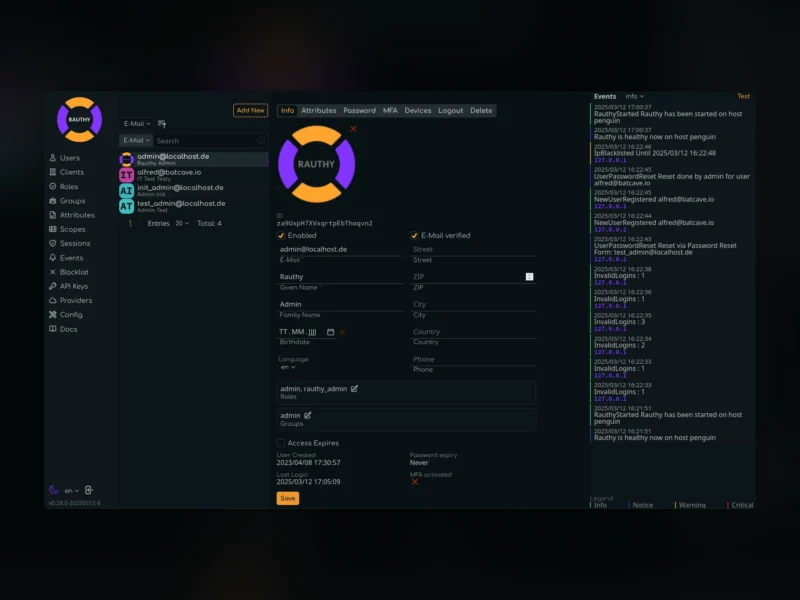
Rauthy is a lightweight single sign-on and identity provider built in Rust, offering OpenID Connect, OAuth 2 and PAM logins in a single self-hosted service. Where most IAM stacks are Java applications that want a database cluster and a gigabyte of heap before they will start, Rauthy is designed to run a complete SSO provider on a Raspberry Pi — and to scale to millions of users from the same binary when you need it to.
Why Rauthy is worth a look
The project started from a blunt observation: Keycloak and its peers are powerful, but the footprint and the operational ceremony are enormous for a homelab, a small company or an IoT fleet. Rauthy answers with a single Rust service, secure defaults out of the box, and an embedded database so there is nothing external to install. It has also been through an independent security audit by Radically Open Security, funded through NLnet’s NGI Zero Core programme, with the findings addressed in v0.32.1.
Key features
- Complete OIDC / OAuth 2 provider — dynamic client registration, RP-initiated and backchannel logout, the device authorization grant, DPoP tokens for decentralized flows, and ephemeral (CIMD) dynamic clients.
- Passkey-first authentication — FIDO 2 / WebAuthn security keys, passkeys that consume no device storage slot, discoverable credentials, and FIDO device attestation. True passwordless accounts (e-mail address plus magic link plus passkey) are supported with no password stored at all.
- PAM logins — custom PAM and NSS modules let your Linux hosts authenticate users against Rauthy, so SSH and console logins join the same identity store as your web apps.
- No mandatory external database — it runs on embedded Hiqlite by default, with PostgreSQL as an option if you already operate one. Automatic, optionally auto-encrypted backups with configurable retention, plus push and auto-restore against S3.
- High availability — multi-node clustering over Hiqlite with automatic leader election, so a single dead node does not take the login page with it.
- Dedicated Admin UI and user account dashboard — manage users, clients, roles, groups, custom scopes, custom user attributes and API keys, while end users get a self-service dashboard for their own profile, MFA devices and sessions.
- Per-client branding and i18n — customise the login page per client and translate every end-user-facing page server-side.
- Protection built in — brute-force and credential-stuffing defences, basic DoS protection, geo-blocking, username enumeration prevention, and additional database-level encryption for the most critical entries.
- Events, auditing and alerting — an event system with optional persistence and notifications over e-mail, Matrix or Slack, plus optional forced MFA for the Admin UI or for individual clients.
- Upstream providers and SCIM — “Login with …” against external identity providers, and SCIM v2 provisioning for downstream clients. There is also a dedicated
forward_authendpoint alongside the standard userinfo endpoint, which makes it a natural fit in front of Traefik, Caddy or nginx.
Deployment and requirements
Rauthy ships as an official container image and as standalone binaries, and it is configured through environment variables with a TOML config option. The usual route is a single container plus a volume for the embedded database; a TLS-terminating reverse proxy in front is expected, since OIDC clients and passkeys both need HTTPS. The first start boots a bootstrap admin account whose password you set once, and from there everything else — clients, users, roles, branding — is managed in the Admin UI. It runs on Linux (x86_64 and ARM), and because the footprint is small it is comfortable on a NAS, a mini PC or a Pi. A PostgreSQL deployment is the alternative if you want the database external and already backed up by your own tooling.
Trade-offs to know about
The emphasis on secure defaults is real, and it occasionally bites: new OIDC clients default to ed25519 token signing and the S256 PKCE flow, which some older or simpler clients cannot handle until you relax the setting per client. The project is also a single-maintainer effort with a fast release cadence, so pin a version and read the release notes before upgrading. If you need a sprawling ecosystem of community extensions, Keycloak still has the larger one; Rauthy’s answer is that you should not need one.
Alternatives
- Keycloak — the heavyweight, extension-rich option from Red Hat, with the widest protocol and integration coverage.
- authentik — a Python-based identity provider with strong flow-based automation and a polished UI.
- Zitadel — a cloud-native OIDC provider with multi-tenancy as a first-class idea.
- Kanidm — another Rust identity server, unusually strong on Unix and SSH integration.
- Pocket ID — a deliberately minimal OIDC provider for passkey logins, if you want the simplest possible setup.
- LLDAP — a lightweight LDAP server with a web UI, a good fit when your applications speak LDAP rather than OIDC.