Authgear
- Platform
- Docker Linux
- Licence
- Apache-2.0 Open source
- Website
- authgear.com
- Source code
- github.com/authgear/authgear-server
Overview
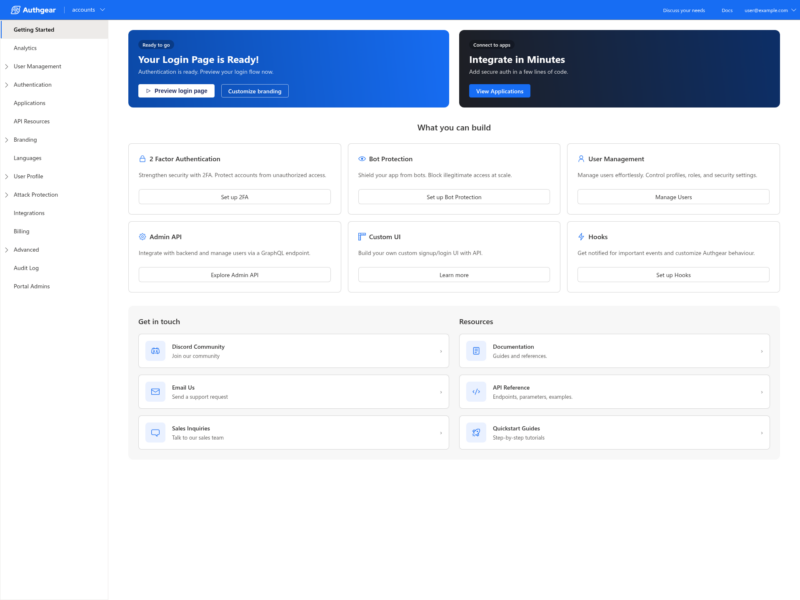
Authgear is an open-source authentication and identity platform positioned as a self-hostable alternative to Auth0, Keycloak, Clerk and Firebase Auth. It is written in Go and ships as four cooperating components: the Authgear server (the core authentication service), the Portal (a web interface for configuring projects, apps, users and authentication flows), AuthUI (the end-user login, sign-up and account-settings pages) and a GraphQL Admin API for automating everything the Portal does by hand.
Instead of building login screens, token handling and user management from scratch, you point an SDK at your Authgear deployment and get standards-based OIDC/OAuth 2.0 authentication with passkeys, one-time codes, social and enterprise connections, multi-factor authentication and role-based access control out of the box. The same codebase powers Authgear Cloud, the vendor’s hosted service, so a self-hosted installation behaves like the commercial product without the per-MAU bill.
Key Features
- Pre-built authentication UI: Customisable sign-up, login and account-settings pages with light and dark themes, so end users get a complete identity experience without front-end work.
- Passwordless and passkeys: Magic links and one-time codes over email, SMS or WhatsApp, plus WebAuthn passkeys and native biometric login on iOS and Android.
- Multi-factor authentication: TOTP with authenticator apps, email and SMS one-time codes, or an additional password as a second factor.
- Standards-based SSO: OIDC, OAuth 2.0 and SAML 2.0, with social connections (Google, Apple, Facebook, LinkedIn and others) and enterprise connections over ADFS and LDAP.
- Management Portal: A browser interface for users, sessions, audit logs, analytics, authentication settings and per-application configuration — the main GUI of the project.
- Admin API: A GraphQL API covering the same resources as the Portal, intended for automation, CI and custom back-office tooling.
- Roles and groups: Built-in RBAC for extending authorisation beyond plain authentication.
- Extensibility: Webhooks on events such as new sign-ups, plus TypeScript hooks for custom logic inside the authentication flow.
- Localisation: Configurable interface languages and editable email/SMS template content.
- Hardening built in: Audit logging, brute-force protection, bot protection and rate limits enabled through configuration.
Deployment
Authgear runs on PostgreSQL and Redis and is distributed as container images. A reference Docker Compose stack is published for local evaluation and small installations, while the Helm chart is the documented route for production Kubernetes clusters. SDKs are available for JavaScript/React, React Native, Capacitor, iOS, Android, Flutter and Xamarin.
Licence
Apache-2.0 (open source). The server, Portal, AuthUI and Admin API all live in the authgear-server repository.