Teleport
- Platform
- Linux macOS Windows Docker
- Licence
- AGPL-3.0 Open source
- Website
- goteleport.com
- Source code
- github.com/gravitational/teleport
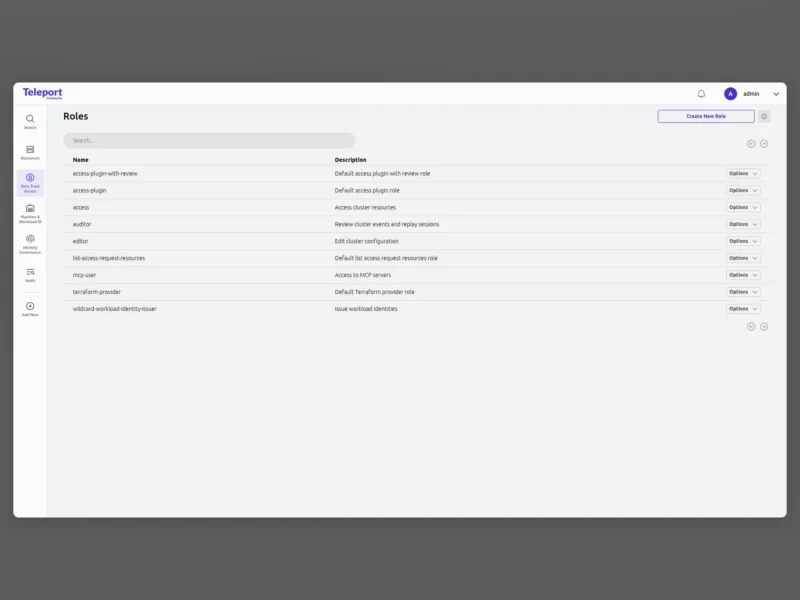
Teleport is an identity-aware access plane for infrastructure: a single Go binary that puts certificate-based authentication, authorisation and session auditing in front of SSH servers, Kubernetes clusters, databases, Windows desktops, internal web apps and cloud consoles. Instead of handing out SSH keys, database passwords and VPN profiles, you issue short-lived certificates from Teleport’s own certificate authority, and every connection passes through a proxy that knows who made it and records what happened. The project is developed in the open by Gravitational under the AGPL-3.0 licence, with a paid Enterprise edition on top of the same codebase.
What it replaces
The usual alternative is a pile of loosely connected tools: a bastion host for SSH, a VPN for anything internal, a password vault for credentials, and a separate log pipeline to work out afterwards who did what. Teleport collapses those into one access layer. Users sign in once — through a local account, GitHub, Google, Microsoft Entra ID, Okta, any OIDC provider or SAML — and get a certificate that names their roles and expires in hours rather than months. Sessions are recorded at the protocol level, so an SSH session is replayed as a terminal capture, a Kubernetes session as a recording of the pod, and a desktop session as RDP video.
Protocols and resources
Server access over SSH is the original core, and the same certificate model extends to Kubernetes clusters, PostgreSQL, MySQL, MongoDB and CockroachDB databases, Windows hosts over RDP, TCP and HTTP applications sitting behind a NAT or firewall, and more recently Model Context Protocol servers. Because access is brokered by the proxy rather than by network position, a resource needs no public IP and no inbound firewall rule: the agent dials out, and the user reaches it through the proxy. That is what lets Teleport stand in for a VPN in flat networks and for a jump host in segmented ones.
Access control and audit
Permissions are expressed as roles that combine allow and deny rules over labels, users and resource types, so an engineer can be granted SSH access to hosts tagged env=staging and database access to clusters tagged team=payments without naming a single host. Roles can require short-lived access requests — a user asks for elevation, a reviewer approves, and the certificate is issued for the duration of the task — which is the just-in-time model the project pushes as its answer to standing privileges. Everything is auditable: the proxy writes an event log of authentications, access requests, file transfers and session start times, and the web UI replays the sessions themselves.
Community Edition and the commercial tiers
The open source build is the full access plane: auth service, proxy, agents for every supported protocol, the tsh client and the web UI, with local users or a single SSO connector. Paid tiers add the features large organisations tend to need — multiple identity providers, role-based access requests with dynamic approval rules, device trust, access lists, and long-term session storage in S3-compatible buckets — plus support. For a homelab or a small team the Community Edition is genuinely usable on its own, and the commercial product is the same binaries with a licence file rather than a different application.
Running it yourself
Deployment is deliberately small: download the tarball or run the published container image, generate a configuration with teleport configure, and start the process with the auth, proxy and agent roles enabled. A single-node install listens on 3025 for the auth API, 3023 for the SSH proxy and 3080 for the web UI, and needs a DNS name with a TLS certificate for anything beyond a test; the proxy can obtain certificates from Let’s Encrypt directly or terminate behind your own load balancer. From there, agents on each server or Kubernetes cluster join with a token, and the tctl CLI creates users, issues invitations and manages roles. High availability means running several auth instances against a shared backend — etcd, DynamoDB or Firestore — and the Kubernetes operator packages the whole topology if you would rather not assemble it by hand. The binary supports Linux on x86-64 and ARM64, with tsh clients for Linux, macOS and Windows.
Alternatives
- Authelia — a lightweight self-hosted single sign-on and 2FA portal for protecting web apps, rather than a multi-protocol access plane.
- Keycloak — a full identity provider with OIDC and SAML, the usual choice when the problem is application login rather than infrastructure access.
- Zitadel — a modern identity platform with multi-tenancy, again aimed at application authentication.
- OAuth2 Proxy — the smallest possible piece of the puzzle: put an SSO check in front of one app and leave everything else alone.
- Authentik — identity provider plus a forward-auth proxy, covering both application and network entry points.
- Kanidm — an opinionated identity management server with SSH key distribution, closer in spirit but without the protocol proxies.