Music Player Daemon
- Platform
- Linux macOS Windows
- Licence
- GPL-2.0 Open source
- Website
- musicpd.org/
- Source code
- github.com/MusicPlayerDaemon/MPD
Overview
Music Player Daemon (MPD) is a server-side music player: a small daemon that owns your music library, decodes the files and plays them through the host’s audio device, while everything else – what is playing, what is queued, the volume, the repeat and random flags – lives behind a network protocol. It was started in 2003 by Warren Dukes and is maintained by Max Kellermann and contributors; the current release is 0.24.19, published in November 2026.
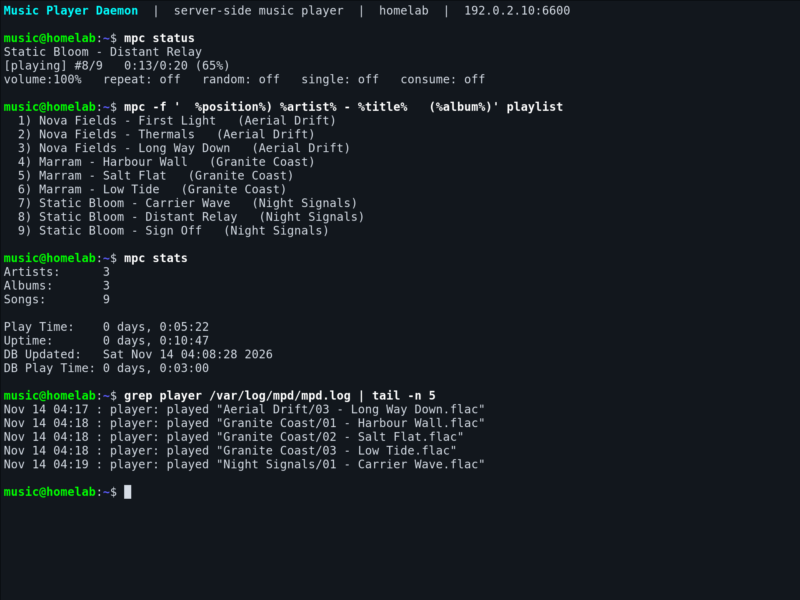
Because the daemon and the interface are separate programs, MPD is the part that stays running on the machine with the speakers, the DAC or the hi-fi. Any number of clients can attach at once over TCP (port 6600 by default) or a UNIX socket – mpc from a shell, an ncurses client such as ncmpcpp, a desktop or phone app, a web front end, a status bar or a script – and they all see the same queue and the same position, because the state belongs to the daemon rather than to the client.
Almost everything beyond the core is a plugin: decoders, audio outputs, database backends, storage backends, playlist plugins. MPD is free software under the GNU General Public License version 2, written in C++, and it is packaged by every major distribution.
Key Features
- One player, many clients – the queue, current song, play position, volume and repeat/random state belong to the daemon; any number of clients attach and stay in sync.
mpcis the reference command-line client, with terminal, desktop and mobile front ends for everything else. - A documented line protocol – plain-text commands and responses over TCP or a UNIX socket, with client libraries for C, C++, Python, Go, Rust and more, so playback is easy to drive from scripts, key bindings and home automation.
- Plugin architecture throughout – decoders, audio outputs, database backends (simple, proxy, UPnP), storage backends (local, NFS, SMB, WebDAV over curl) and playlist plugins are all loadable pieces rather than hard-wired code.
- Outputs from ALSA to HTTP – ALSA, PulseAudio, PipeWire, JACK, OSS, sndio, OpenAL, CoreAudio, Snapcast and Shoutcast-style streaming, plus Null, FIFO and recorder outputs for testing and capture. Several outputs can run at the same time.
- Wide format coverage – FLAC, MP3, Ogg Vorbis, Opus, AAC, WavPack, Musepack, WAV/AIFF/CAF through libsndfile, DSD (DSF and DFF), tracker modules, MIDI through FluidSynth or WildMIDI, SID and game-music formats, and anything else ffmpeg can decode.
- Bit-perfect and audiophile paths – integer-only output, DSD passthrough, configurable resamplers, ReplayGain and MixRamp, and crossfading when you want it.
- Gapless playback and a real library – the library is an indexed database rather than a rescan at startup, so search and queueing stay instant on large collections; albums play without gaps and CUE sheets split single-file rips.
- Partitions and access control – partitions give different clients their own queue on the same daemon, and per-client passwords limit what a connection is allowed to change.
Requirements and Installation
MPD needs a machine with an audio output and a music directory. Linux, the BSDs and macOS are the primary targets and Windows builds exist; on Debian and Ubuntu, apt install mpd installs the daemon and apt install mpc the command-line client, while Fedora, Arch, Alpine and the BSD ports trees ship it too. The configuration file names the music directory, the database file and at least one audio output, and the packaged systemd unit runs it as the mpd user, with socket activation available.
A typical home setup keeps the collection on a NAS or home server, mounts it or reaches it through a storage plugin, points music_directory at it and enables the output that matches the hardware – then every other machine only needs a client. The manual at musicpd.org covers configuration, the protocol and the full plugin reference.
Alternatives
- cmus – a self-contained terminal player: the same keyboard-driven feel, but the player and the interface are a single program on a single machine.
- Navidrome – a self-hosted streaming server with a web interface and Subsonic-compatible API, aimed at phones and browsers rather than a local audio device.
- Strawberry – a Qt desktop player with a library manager and playlists, for one desktop rather than a daemon.
MPD’s closest relationships are with its clients rather than its rivals: ncmpcpp and similar terminal front ends exist only to drive a daemon like this one, and Mopidy takes the opposite route – a Python music server that speaks the MPD protocol, so existing MPD clients can control it.