Tauon Music Box
- Platform
- Linux Windows macOS
- Licence
- GPL-3.0 Open source
- Website
- tauonmusicbox.rocks
- Source code
- github.com/Taiko2k/Tauon
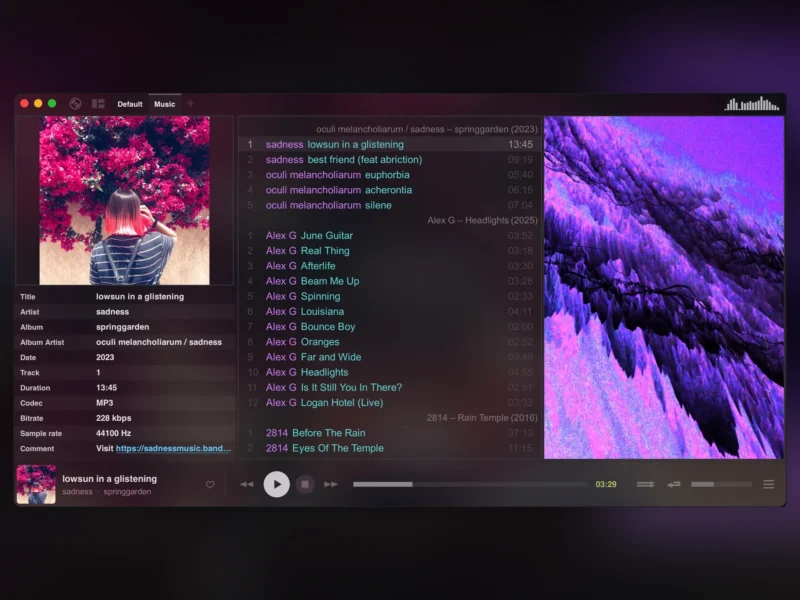
Tauon is a desktop music player built around playlists rather than a browsable tree: import a collection into one playlist, then carve smaller ones out of it by search, drag and drop or a smart-playlist rule. It treats folders as albums — the interface uses the two words interchangeably — so a properly tagged library laid out one album per folder is what it is designed for. The application is a C++ launcher that owns SDL3 and the window, with an embedded CPython interpreter running the interface and its own Phazor audio libraries handling decoding. It is released under GPL-3.0, with no ads, no tracking and no account.
A playlist-first library
Importing is drag and drop from the file manager, or Import Music Folder from the main menu, which pulls the system Music folder in as a playlist called “Music”. Tauon does not watch folders in the background, so after adding music you right-click a playlist tab and choose Rescan Folder, or reload every playlist’s folders from the database menu. Smart playlists are short codes that filter, sort and shuffle the library without rebuilding a playlist by hand, and the gallery view browses the same library by cover art next to the tracklist.
Layouts, themes and visuals
The window is assembled from widgets — tracklist, side panel, gallery, lyrics, visualiser — so a layout can be built from scratch or picked from the ready-made views, and mini mode collapses the whole player into a small always-on-top window. Themes are generated from the album art of the current track, and MilkDrop presets run through projectM for the full-screen visualiser. Keyboard shortcuts cover the usual transport and playlist switching, and gamepad mappings are available for driving it from a couch.
Formats and playback
Gapless playback covers FLAC, Opus, Ogg Vorbis, MP3, AAC, ALAC, WavPack, APE, TTA and DSD, CUE sheets are read so a single-image rip appears as separate tracks, and tracker formats such as MOD and SPC play as well. An archive extractor unpacks a download and imports it in one step. Transcoding and sync push a playlist to a phone or portable player in a chosen format, and playlists can be exported and imported again.
Tag editing, lyrics and radio
A tag editor handles batch edits, with MusicBrainz lookup by audio fingerprint when tags are missing or wrong. Synced lyrics can be displayed, fetched and written back to file. Internet radio stations sit alongside local playlists, scrobbling is built in, and play counts and other listening statistics are kept locally in the app’s data directory.
Network sources and remote control
Music can also stream from a Plex, Jellyfin or Subsonic-compatible server, which lets a small local machine play a library that actually lives on a NAS. Chromecast output and Discord presence are supported, there is a remote control endpoint for driving playback from another device, and command-line options let a session start on a particular view.
Tauon ships as a Flatpak on Flathub (the sandbox needs the documented extra steps after installation), in Arch’s extra repository, and as portable Linux archives for x86-64 and arm64, a Windows installer and a macOS disk image on the releases page. Building from source needs Python 3.11 or newer, CMake 3.20 or newer, an SDL3 toolchain and the codec development libraries. Active development continues, with v13.1.1 published at the end of October 2026.
Other playlist-oriented players already in the directory include Strawberry, Quod Libet, Clementine and Audacious.