Sortarr
- Platform
- Docker Web Self-hosted
- Licence
- MIT Open source
Overview
Sortarr is a read-only analytics and organisation tool for media libraries. You point it at the tools that already manage your collection – Sonarr and Radarr for acquisition, Plex, Jellyfin or Emby for playback – and it pulls everything into one interface where you can see what is missing, what is mismatched, and where your storage is being spent badly. It never touches the files themselves: no renames, no deletes, no changes to your Sonarr or Radarr configuration.
The idea is to add a data-driven management layer on top of the Arr stack rather than another automation daemon. Sortarr reads live data from your providers, overlays playback and watch-history statistics from Tautulli, Jellystat, Streamystats, Tracearr or Plex itself, and turns all of that into screens you can actually act on. It ships as a Docker image and runs from a web interface, released under the MIT licence.
Key Features
- One view across providers: analyse libraries from Sonarr, Radarr, Plex, Jellyfin or Emby side by side instead of opening each tool in turn.
- Playback history overlay: merges watch data from Tautulli, Tracearr, Jellystat, Streamystats or Plex, so a title’s real popularity sits next to its file attributes.
- Mismatch Center: compares providers and surfaces mismatch and playback-match diagnostics when one tool disagrees with another about the same item.
- Series to episode drill-down: moves from an Arr library into seasons and episodes, and across the Plex and Jellyfin-backed views, without losing context.
- Multiple instances: supports several Sonarr and Radarr servers at once with cross-instance visibility, which matters if you split libraries by type or location.
- Filtering and search: search, per-column filters, chips and advanced rules make a very large library navigable in a few clicks.
- Detailed media attributes: size, bitrate, codecs, languages, FPS and bits-per-pixel-frame where the source exposes them, which is how you spot the file that should be re-encoded.
- Provider-aware insights: sessions, activities, library views and match health for Plex, Jellyfin and Emby.
- Three authentication modes: built-in Basic Auth, Basic Auth with a local-network bypass, or reverse-proxy authentication with a trusted upstream header.
Why Use It
Most home media setups have the automation side solved and the inventory side not. Sonarr and Radarr know what they downloaded; Plex knows what was watched; neither tells you that five series are sitting on half a terabyte with zero plays, or that the same film exists twice at different bitrates. Sortarr collects those scattered facts into comparisons you can read in one sitting, and it does it without write access to your library, so there is no risk to your files.
Common Use Cases
- Pruning a bloated library: sort by size against watch history to find content that has never been played.
- Spotting quality drift: compare bitrate, codec and BPPF across a series to see which episodes were grabbed from a poor source.
- Auditing two Arrs: check whether a film exists in both a 1080p and a 4K instance, and whether Plex agrees.
- Diagnosing match problems: use the mismatch views when Plex and Jellyfin disagree about which title a file belongs to.
Running It
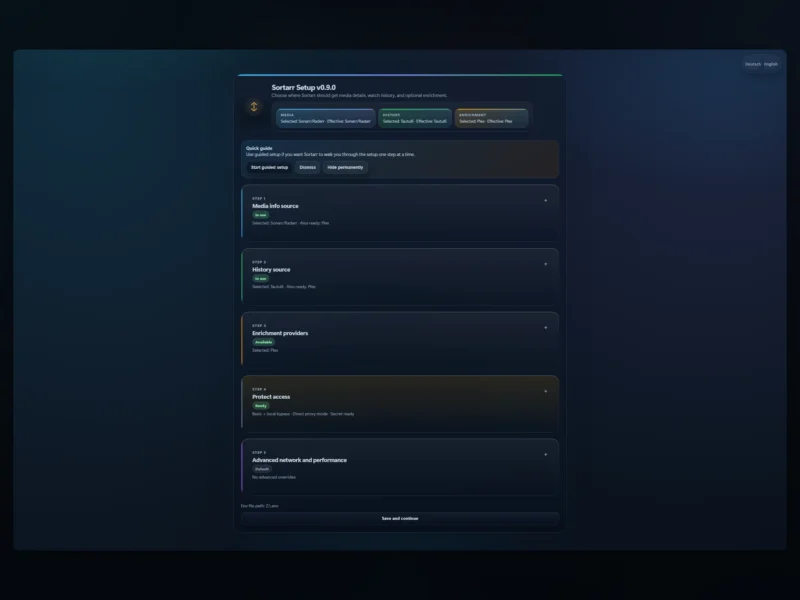
Sortarr is distributed as a container image (ghcr.io/jaredharper1/sortarr) and configured through environment variables, including an optional Unraid template in the repository. You choose a media source (Sonarr and Radarr, or Plex, Jellyfin and Emby directly), a history source and optional enrichment providers, then protect the interface with one of the three auth modes. The guided setup screen walks through those steps on first run; deployment, reverse-proxy and provider guides live in the project wiki. The author has moved the project into maintenance mode as of the 0.9.0 release, so expect fixes for reported issues rather than a stream of new features.