Radarr
- Platform
- Docker Linux Windows macOS Web Self-hosted
- Licence
- GPL-3.0 Open source
- Website
- radarr.video
- Source code
- github.com/Radarr/Radarr
Overview
Radarr is a movie collection manager for Usenet and BitTorrent users. It watches the RSS feeds of the indexers you give it, finds new and better releases of the films you monitor, hands them to your download client, and then imports, renames and files the finished copies into a library layout your media server can read. It is the film half of the Servarr family (Sonarr handles TV, Lidarr music, Readarr books, Prowlarr indexers) and is released under GPL-3.0.
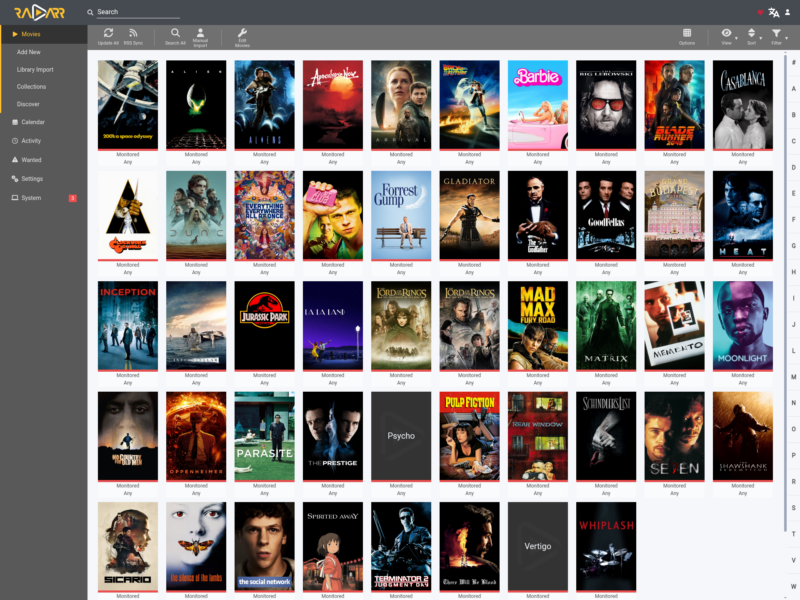
Everything is driven from a web interface: the sidebar gives you Movies, Add New, Collections, Discover, Calendar, Activity and Wanted, with settings for media management, quality profiles, custom formats, indexers, download clients, import lists, notifications and metadata.
Key Features
- Automatic movie hunting: follows the RSS feeds of every indexer you add and grabs a release as soon as one of your monitored films appears, instead of you searching trackers by hand.
- Library organisation: renames and moves completed downloads into per-film folders using a naming template you control, with separate templates for the folder name, file name and multi-part films.
- Quality profiles and custom formats: score releases by resolution, source, edition and release group, so a preferred 1080p WEB-DL beats a rough copy without changing the rest of the library.
- Quality upgrades: when a better version of a film you already own turns up, Radarr grabs it and replaces the old file instead of leaving you with two copies.
- Collections: treats a franchise as one monitored unit — add a collection and Radarr tracks every film in it, including future entries.
- Discover and import lists: browse TMDB lists inside Radarr, or pull watchlists and lists from Trakt, IMDb, Plex and other Radarr instances so a fresh install rebuilds itself.
- Indexers and download clients: Newznab/Torznab indexers for Usenet and torrent trackers, wired to SABnzbd, NZBGet, qBittorrent, Transmission, Deluge and the rest.
- Calendar, Wanted and Activity: release dates for what is coming, lists of missing and cut-off films, and a live queue of what is downloading or importing.
- Notifications: the Connect settings push grabs, imports, upgrades and health warnings to Discord, Telegram, ntfy, Plex, Kodi, Jellyfin/Emby and other supported services.
- API and mobile-friendly UI: a documented API key for automation, and a responsive interface for checking the queue from a phone.
Why Use Radarr
Keeping a film library current by hand is a loop of checking release dates, searching a tracker, picking a release, waiting, then renaming and moving the file. Radarr turns that loop into a rule set — monitor this film, prefer this quality, keep this collection — and runs it unattended. Because every import goes through the same naming template and folder layout, media servers stop showing duplicate or unidentified entries, and an upgrade pass replaces tired copies rather than piling new ones on top.
Typical Uses
- Running a home media server where new releases of monitored films arrive without anyone searching for them.
- Upgrading a library from low-bitrate copies to better releases, film by film, as they appear.
- Tracking whole franchises through Collections instead of adding each sequel separately.
- Feeding Jellyfin, Plex, Emby or Kodi with consistently named files and artwork.
- Keeping a seedbox download queue organised while the library itself lives on a NAS.
Getting Started
Radarr ships as an official container image, native builds for Windows, Linux and macOS, and packages for the common NAS platforms. All state lives in a single data directory, so the install can be backed up, moved or run on another host without touching the library. After the first start the web interface asks you to enable authentication; then you add a root folder, an indexer and a download client, and the library begins to fill. Prowlarr can manage indexers for Radarr and Sonarr together, and Bazarr adds subtitles.