RadaRec
- Platform
- Docker Linux Web
- Licence
- GPL-3.0 Open source
- Source code
- github.com/TheWicklowWolf/RadaRec
Overview
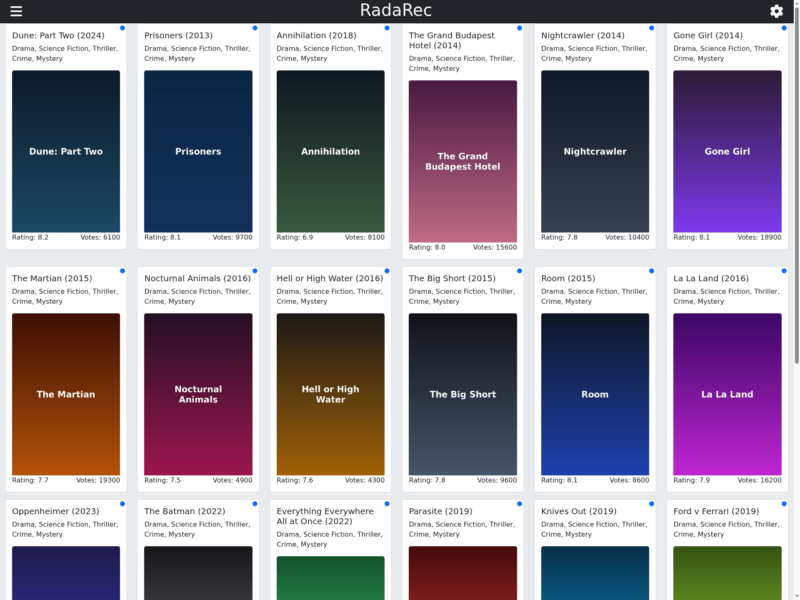
RadaRec answers the question that follows every good film: what next? It reads your Radarr library, lets you tick the titles you liked, and asks TMDB for each one’s recommendations, filtering the results by rating, vote count and language before you ever see them. What comes back is a poster wall of candidates, each with a button to push it straight into Radarr at your chosen root folder, quality profile and metadata profile.
The point is to keep discovery inside the tool that already holds your collection. Instead of browsing a website for a title, copying its ID and adding it by hand in Radarr, you select what you enjoyed from a list and walk away with a shortlist you can add in one click. It is a small, single-purpose container — one Python process, one config file, one Radarr instance — which is the right size for the job.
Key Features
- Similar-movie discovery: TMDB recommendations seeded from the Radarr movies you select, rather than a generic trending list.
- Rating and vote thresholds: a minimum rating (default 5.5) and minimum vote count (default 50) keep the long tail out of the grid.
- Language filter: restrict results to a single ISO-639 language, or accept everything.
- One-click add: every card carries an Add to Radarr button that uses your root folder, quality profile, metadata profile and optional automatic search.
- Library sidebar: the whole Radarr catalogue is listed alphabetically with select-all, so seeding a run takes a moment.
- Dry-run mode: run a discovery pass without adding anything, to see what it would have picked.
- Scheduled passes: optional auto-start with a configurable delay, so a fresh set of suggestions is waiting when you next open it.
- Settings in the UI or in compose: every value is editable in the settings dialog and overridable with environment variables (
radarr_address,tmdb_api_key,quality_profile_id, and the rest). - Light and dark themes: a switch in the settings dialog, dark by default.
Why Use It
Recommendation engines are built to sell you something; RadaRec is built to fill a shelf you already own. Because the seed comes from your own library, the suggestions tend to land inside the taste you have already collected — prestige thrillers beget prestige thrillers, and a Denis Villeneuve run turns into a sensible shortlist instead of a streaming service’s front page.
The three filters do most of the quiet work. Rating and vote floors remove the obscure titles that look fine until you read the vote count, and the language filter stops a search for British crime drama from returning films you cannot watch. What survives that is usually worth adding, and adding it is one click rather than a trip to Radarr’s search page.
Use Cases
- Filling a genre shelf: seed from two or three films you loved in a genre and work through the shortlist over a few evenings.
- Following a director or actor: pick their films you already own and let the recommendations surface adjacent work.
- Keeping a library fresh: schedule a pass so there are always candidates waiting, instead of hunting for something to watch.
- Shared libraries: add quality-controlled suggestions to a household Radarr without giving everyone the API key.
It is used from a browser on the same network as the host, and its configuration lives in a single config directory that you mount as a volume.
Licence
Free and open source — GPL-3.0. It needs two things you supply: a reachable Radarr instance with its API key, and a free TMDB API key for the recommendation data.