MediaManager
- Platform
- Docker Linux Web
- Licence
- AGPL-3.0 Open source
- Source code
- maxdorninger.github.io/MediaManager/
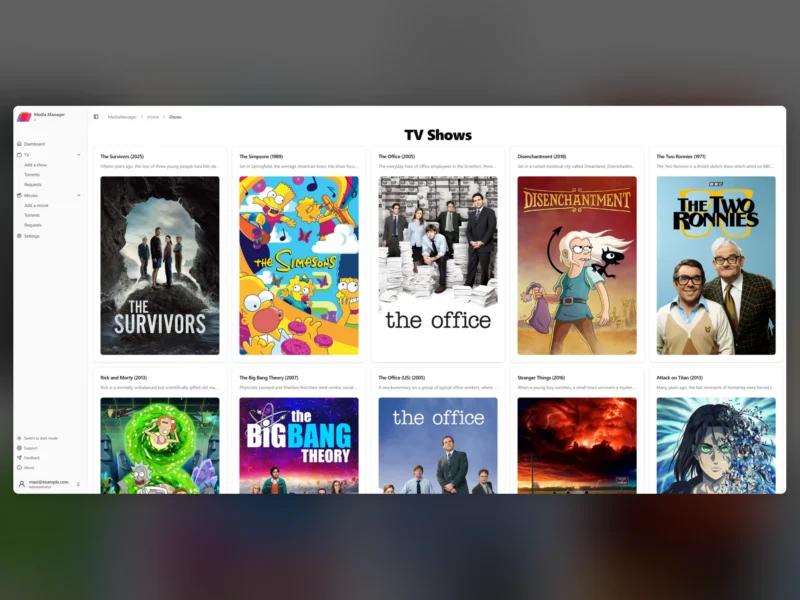
Overview
MediaManager is a self-hosted library manager for films and TV shows, built as a single replacement for the sprawl of separate “Arr” applications — one installer, one web interface, one place where a library is scanned, searched and downloaded. Metadata comes from TMDB and TVDB, releases are found through Prowlarr or Jackett, and the chosen download is handed to qBittorrent, Transmission or SABnzbd.
The pitch is less about doing anything the Arr stack cannot do than about doing it once. The same page lists what you own, shows what is trending, and starts a search for what is missing. For a homelab that has accumulated four containers, four configuration formats and four sets of API keys, collapsing them into one container and one config.toml is the whole argument.
Key Features
- One interface for films and TV: separate libraries, each with its own scan state, torrent view and request list, behind a single login.
- Custom libraries: any number of extra film or TV folders — for example one per genre — each with its own name and path.
- Metadata: TMDB and TVDB for titles, posters and descriptions, including multi-language metadata so a library can be added and searched in a language other than English.
- Indexers: Prowlarr and Jackett, queried with IMDb/TMDB/TVDB IDs where the indexer supports them, which sharpens results and shortens Prowlarr response times.
- Download clients: qBittorrent, Transmission and SABnzbd, configured independently.
- Scoring rulesets: prefer, avoid or reject releases by title keyword or indexer flag — H.265 over H.264, no CAM or TS rips, freeleech only — with rulesets assigned per library.
- Import existing media: a Sonarr or Radarr library can be adopted in place. Folders named
Show (Year) [tmdbid-1234]orShow (Year) {tvdb_12345} [x265]are recognised, and the old root folders are prefixed with a dot so the two managers stop fighting over them. - Notifications: SMTP email, Gotify and Ntfy.
- OAuth/OIDC login for putting the UI behind an identity provider instead of a local password.
- Deployment details: one rootless image (published on quay.io and GHCR) with PostgreSQL 17, plus a configurable URL prefix, custom port and symlink handling for reverse-proxy setups.
Typical Uses
- Replacing a Prowlarr, Jackett, Sonarr, Radarr and Bazarr set-up with a single container.
- Running a small media server where one interface for both films and TV is worth more than per-tool depth.
- Taking over an existing Arr-managed library without renaming folders or re-downloading anything.
- Keeping 4K, 1080p or genre-split collections as separate libraries with different scoring rules.
- Putting the library behind OIDC and receiving notifications in Gotify or Ntfy rather than by email.
Getting Started
The project ships a Compose file: download docker-compose.yaml and config/config.toml from the latest release, mount your media at /data, and run docker compose up -d — the UI then answers on port 8000. A PostgreSQL 17 container is part of the same Compose file, and Nix flakes are documented as a community alternative. Configuration is a single TOML file covering the database, download clients, indexers, scoring rulesets and notifications, and the documentation walks through each section. The latest tagged release is v1.12.3 (February 2026), with repository commits through July 2026; the project has roughly 3.3k stars on GitHub.
Licence
Free and open source, licensed under the GNU Affero General Public License v3.0 (AGPL-3.0); the full text is in the repository’s LICENSE. The developer accepts sponsorship on GitHub Sponsors and Buy Me a Coffee, and DigitalOcean provides credits for a hosted MetadataRelay offered as an optional metadata provider — the self-hosted software itself is unrestricted.