Cert Warden
- Platform
- Linux Docker
- Licence
- Proprietary (non-commercial) Source-available
- Website
- certwarden.com/
- Source code
- github.com/gregtwallace/certwarden
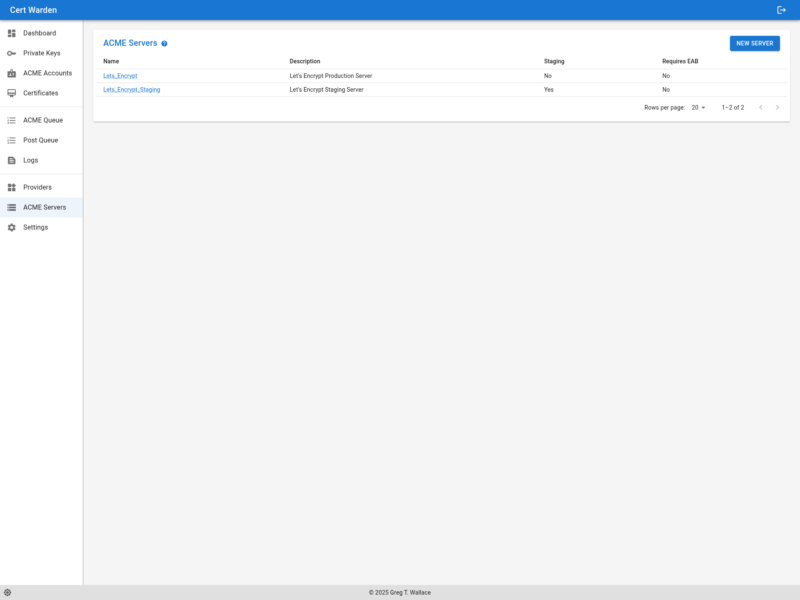
Cert Warden is a self-hosted, centralised ACME client: instead of installing a certificate-renewal agent on every server you own, you run Cert Warden once and let your infrastructure fetch its certificates from it. It drives Let’s Encrypt (or any ACME-compatible CA) on your behalf, stores the private keys and issued certificates, and exposes a simple API that other machines poll with their own API keys to retrieve the key and certificate pair they are entitled to. The project is written in Go with a Vue-based web interface, and the vendor publishes a ready-made container image as well as binary releases.
How it works
You add one or more ACME accounts, point them at the certificate authority of your choice, and create certificates whose subject and subject alternative names describe the hosts you need to secure. Cert Warden gathers the domain validations itself — either over HTTP-01 through its built-in challenge server, or over DNS-01 using the provider integrations it ships with — then orders, downloads and stores the result.
- A background ordering service renews certificates before expiry, and honours ACME Renewal Information (ARI) so renewals follow the CA’s own schedule when it publishes one.
- Short-lived certificates are handled automatically, with validity and renewal thresholds configurable.
- Each certificate carries its own API key, so a consumer machine can fetch only the key and certificate it needs, and a key can be rotated without touching the others.
- Separate staging and production ACME accounts, so you can rehearse a DNS or proxy configuration without burning production rate limits.
- Post-queue hooks let a certificate trigger a reload or restart on the machine that consumes it, and every ACME request is logged for troubleshooting.
- A settings page exposes automatic data backups, and the whole state lives in a single SQLite database inside the data volume.
Where it fits
Cert Warden is aimed at home labs and small-to-medium fleets whose machines cannot reach the internet for a DNS-01 challenge, or where installing Certbot and a provider plugin on every host is impractical: one instance with your DNS provider credentials does the validation for everyone. If you only need HTTPS termination, a reverse proxy that handles ACME itself may be simpler — see the alternatives below.
Licence
NOT open source. Cert Warden is proprietary software: its licence grants “personal, private (non-commercial) use” only, with all rights reserved by the author. The source code is publicly readable on GitHub, which is why it is classed as source-available rather than open source, but commercial use is not permitted by the published terms. The software itself is free to download and run for personal use; there is no paid tier or hosted option offered.