OpenBao
- Platform
- Docker Linux Web
- Licence
- MPL-2.0 Open source
- Website
- openbao.org/
- Source code
- github.com/openbao/openbao
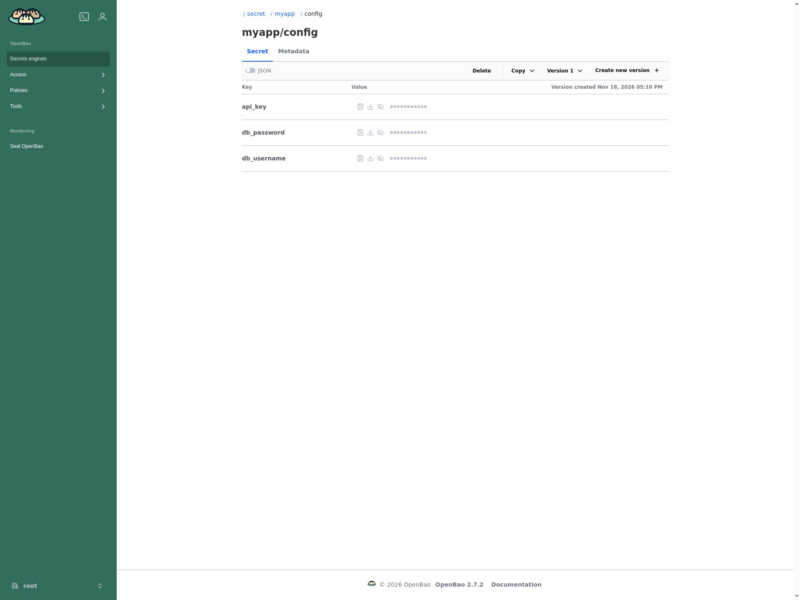
OpenBao is an open-source secrets management platform that stores, manages and distributes sensitive data — database credentials, API keys, certificates, encryption keys — behind a single audited API. It began in 2024 as a community-governed fork of HashiCorp Vault after Vault moved to the Business Source Licence, and is now run under open governance as an OpenSSF project.
The model will be familiar to anyone who has run Vault: you start a server, unseal it, and mount secret engines and authentication methods against it. Applications and operators read secrets over HTTP with a token, and every access is written to an audit log. Because the fork keeps Vault’s API, existing clients, SDKs and tooling work with OpenBao largely unchanged.
Core capabilities
- Encrypted secret storage — arbitrary key/value secrets are encrypted before they reach the storage backend, whether that is Raft, a filesystem mount, Consul or object storage.
- Dynamic secrets — credentials are generated on demand for databases, cloud providers and PKI, then automatically revoked when their lease expires.
- Data encryption as a service — encrypts and decrypts data without storing it, so applications can keep ciphertext in their own database.
- Leasing and renewal — every secret carries a lease; clients renew while they still need it and the server revokes it afterwards.
- Revocation — revoke a single secret, or a tree of them (everything a user accessed, or every credential of a given type), which matters during key rotation and incident response.
- Fine-grained access control — ACL policies written in HCL decide which token can touch which path and with which capability.
- Web UI and CLI — a browser console ships with the server, alongside the
baocommand line client.
Deployment
OpenBao ships as a single Go binary with no external dependencies, plus official container images for quay.io and Docker Hub. For a quick look it runs in development mode with bao server -dev, which starts an in-memory server with a root token and the admin UI; production deployments use a configuration file with TLS, a storage backend and a seal or auto-unseal mechanism. High availability is supported through integrated storage (Raft) or a shared backend.
Licence
Open source. OpenBao is released under the Mozilla Public Licence 2.0 (MPL-2.0), an OSI-approved licence, with development governed in the open by the OpenBao technical steering committee.