Infisical
- Platform
- Docker Linux
- Licence
- MIT Open source
- Website
- infisical.com
- Source code
- github.com/Infisical/infisical
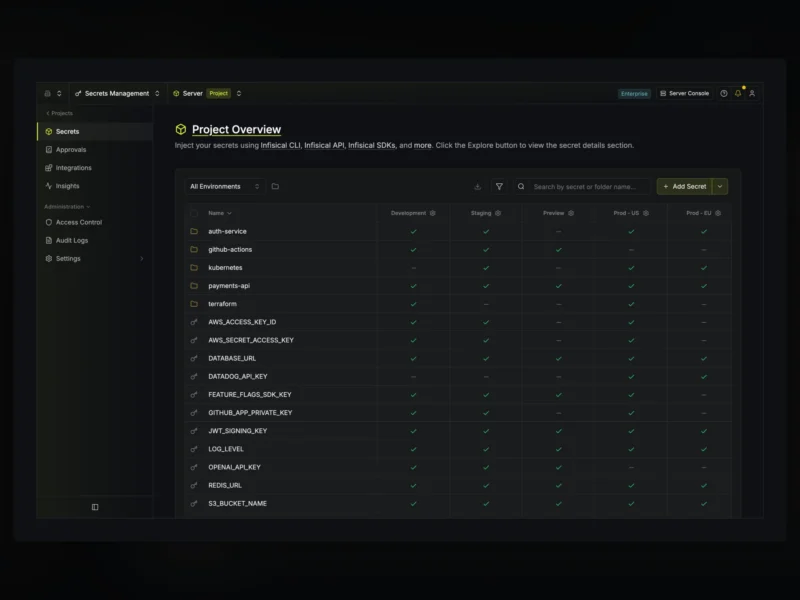
Infisical is an open-source security infrastructure platform that keeps application secrets, X.509 certificates, encryption keys and privileged access behind one dashboard, one API and one policy model. The core is MIT-licensed and self-hostable with Docker Compose, and the vendor’s hosted Infisical Cloud runs the same code, so a team can start managed and move to its own infrastructure later without changing the clients it already uses.
Secrets management
Secrets live in projects, split by environment and folder, with versioning and rollback to any earlier value, rotation schedules and side-by-side comparison between environments. Applications read them at runtime through the CLI, the SDKs or the Infisical Agent, which injects values into a process without touching its code; the Kubernetes Operator does the same for workload secrets and reloads deployments when a value changes. Sync integrations push the values outward to cloud secret stores, CI providers and infrastructure tools such as Terraform and Ansible.
Leak prevention and scanning
The CLI scans files, directories and full git history for 140+ secret types, and a pre-commit hook blocks any commit that contains one. Server-side scanning covers GitHub, GitLab and Bitbucket repositories, with findings triaged in the dashboard.
Certificates, keys and privileged access
A private CA hierarchy can be built inside Infisical, or an external CA — Let’s Encrypt, DigiCert, Microsoft AD CS — wired in so certificates keep coming from the existing PKI; issuance supports ACME, EST and SCEP enrolment, with renewal, revocation, expiry alerting and syncs to AWS Certificate Manager or Azure Key Vault. A built-in KMS holds cryptographic keys and exposes them through the API, over KMIP, or for Kubernetes encryption at rest and Sigstore signing, so applications never store the keys themselves. For privileged access, Infisical brokers just-in-time credentials to PostgreSQL, SSH servers, Kubernetes and Active Directory, records sessions for replay, and can scan infrastructure to discover privileged accounts. Agent Vault extends the same idea to AI agents: their requests leave through a proxy that attaches the real credential at the network boundary, so a prompt-injected agent has nothing to leak, with per-session grants and logs.
Deployment and requirements
Self-hosting is a Docker Compose stack — PostgreSQL, Redis, the API and the web frontend — started from the repository’s docker-compose.prod.yml, after which the first account is created in the browser. Kubernetes installs use the published Helm chart, and the vendor’s upgrade tool plans version jumps between releases. The CLI doubles as a local secret scanner, which makes it usable even before a server exists.
Open source and paid editions
The repository is MIT Expat licensed, with the exception of the ee/ directories, which hold premium enterprise features that require a separate Infisical licence — so check the feature pages before planning a deployment, as parts of the platform above are paid-edition only. Infisical Cloud and the enterprise self-hosted offering are the commercial paths; the community edition is what this listing is about.
Related tools
- Passbolt — open-source password and credential sharing for teams, if what you need is a shared vault rather than machine-readable secrets.
- Vaultwarden — a lightweight Bitwarden-compatible server for human passwords.
- Keycloak — identity and SSO, complementary when the identities reading the secrets come from a directory.