Private Captcha
- Platform
- Docker Web
- Licence
- PolyForm Noncommercial 1.0.0 Source-available
- Website
- privatecaptcha.com
- Source code
- github.com/PrivateCaptcha/PrivateCaptcha
What it does
Private Captcha is a CAPTCHA service that protects forms with a proof-of-work challenge rather than with image puzzles. When a visitor submits a protected form, the browser solves a short computational challenge and the widget passes a signed solution to your server, which verifies it against the API. There is nothing to read, click through or classify, and no behavioural profiling: the service states that it does not track users or process personal data, which keeps it in line with GDPR expectations.
How the challenge works
- Adaptive difficulty — the puzzle cost rises with the traffic the service sees, including compute- and memory-hard variants, so a bot farm pays far more than a single human browser.
- Difficulty rules — challenge strength can be adjusted per traffic source, country, user agent, IP address or individual form.
- Form proxy — a form can post through the service so that its webhook stays hidden behind rate limiting and the CAPTCHA check.
- Widget — a lightweight, styleable widget with inline and invisible modes, driven by a sitekey that is scoped per property (domain).
- Statistics — per domain and per organisation reporting on challenges requested, verified and the verification rate.
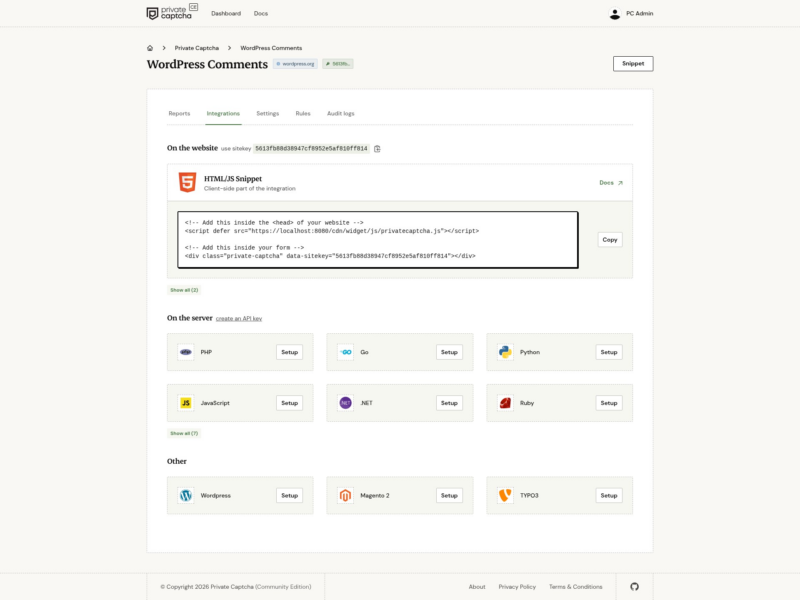
- Integrations — server libraries for PHP, Go, Python, JavaScript, .NET and Ruby, plus packaged instructions for WordPress, Magento 2 and TYPO3.
Self-hosting
The backend is written in Go and stores its data in PostgreSQL and ClickHouse. A separate self-hosting repository ships a Docker Compose stack (application, PostgreSQL and ClickHouse containers) plus a bootstrap script that generates the environment file, so a community-edition instance can be brought up on your own hardware and served from your own domains instead of the hosted service.
Licensing
Not open source. The project is published under the PolyForm Noncommercial License 1.0.0, which is a source-available licence, not an OSI-approved one: the code is public and can be self-hosted, but the free community edition is limited to non-commercial use. Commercial use requires an enterprise licence under the vendor’s EULA. The hosted plans and their limits are listed on the project site.
Alternatives
- CrowdSec — open source intrusion detection and remediation that blocks abusive traffic before it reaches a form.
- SafeLine — open source web application firewall with bot and rate-limit protection.
- mCaptcha — AGPL-3.0 proof-of-work CAPTCHA that you can self-host without a licence restriction.
- Anubis — MIT-licensed proof-of-work challenge that fronts an entire site behind a browser check.