SafeLine
- Platform
- Docker Linux
- Licence
- GPL-3.0 Open source
- Website
- waf.chaitin.com
- Source code
- github.com/chaitin/SafeLine
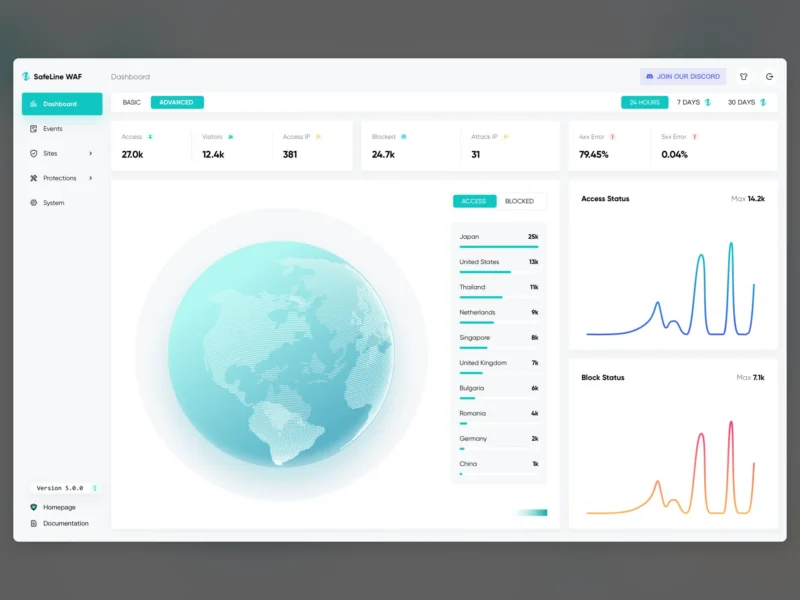
SafeLine is a self-hosted web application firewall and reverse proxy that stands between the internet and your web apps, filtering and blocking malicious HTTP/S traffic before it reaches the application. It is written in Go by Chaitin and released under GPL-3.0; the repository reports more than 23,000 stars, and the vendor counts over 700,000 installations protecting some two million sites. Because the protection sits in front of the app as a reverse proxy, nothing in the application itself has to change.
What it blocks
- Injection attacks — SQL injection, XSS, code injection, OS command injection, CRLF injection, LDAP injection and XPath injection
- Exploit classes — remote code execution, XXE, SSRF, path traversal and web backdoors
- Abuse traffic — brute-force attempts, HTTP floods and aggressive bot traffic
Protection controls
- IP-based rate limiting, to throttle traffic that exceeds a defined rate
- Access control lists (web ACL) for allow and deny rules
- Anti-bot challenge — human visitors pass, crawlers and automated clients are blocked
- Authentication challenge — every visitor must enter a password before the site is served, useful for staging sites and internal tools
- Dynamic protection — HTML and JavaScript in responses are encrypted afresh on each visit
How well it detects
Chaitin publishes an evaluation over 33,669 attack samples that compares SafeLine against ModSecurity (OWASP CRS level 1) and Cloudflare’s free tier. In the Balanced policy SafeLine detects 71.65% of samples with 0.07% false positives; in Strict mode detection rises to 76.17% at 0.22% false positives, for an accuracy of 99.38%. ModSecurity level 1 is listed at 69.74% detection but 17.58% false positives, Cloudflare free at 10.70%. These are the vendor’s own numbers rather than an independent audit, but the false-positive gap is the interesting part: a WAF that blocks legitimate customers is usually the reason deployments get switched off.
Deployment
SafeLine runs on Linux and installs with Docker; the project’s install guide at docs.waf.chaitin.com covers the one-command deployment, after which applications, upstreams and policy are configured from the management console over HTTPS on its own port (the public demo runs at demo.waf.chaitin.com:9443). A site is protected by pointing its DNS record or upstream at SafeLine instead of at the origin server. Three integrations extend it beyond a single host: an MCP server for AI-assisted management and control, an ingress-nginx plugin that protects Kubernetes ingress traffic, and a Kong plugin for APIs and services.