CrowdSec Manager
- Platform
- Web Docker
- Licence
- MIT Open source
- Source code
- github.com/hhftechnology/crowdsec_manager
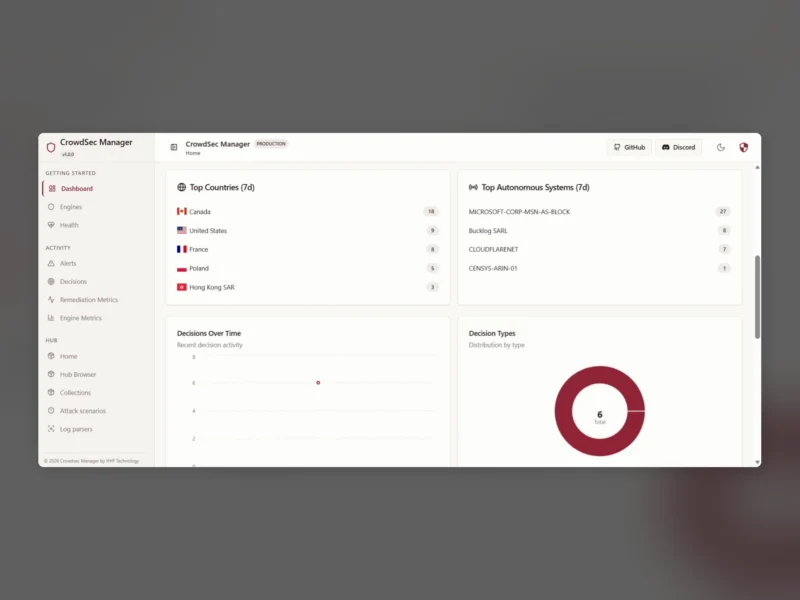
CrowdSec Manager is a self-hosted web interface for the CrowdSec security stack — the local management and monitoring layer that CrowdSec itself leaves to cscli and log files. It presents the engine’s alerts, decisions, allowlists, bouncers, hub content, logs and backups as a browsable dashboard, and it talks to the local CrowdSec API rather than to a cloud console. The backend is Go, the frontend React/TypeScript with Shadcn UI, and the whole thing ships as a Docker image you run next to your CrowdSec container; a companion iOS/Android app exposes the same views from a phone.
Key Features
- Alerts and decisions analysis — filterable results tables plus an inspect modal and overview charts, so you can see why a scenario fired, which IP it banned, and how decisions are distributed by type and over time instead of scrolling raw JSON.
- Hub management — browse CrowdSec Hub categories and install or remove collections, log parsers, scenarios, postoverflows, AppSec rules and remediation components from inside the UI, with an install-mode selector.
- Allowlists, whitelists and bouncers — manage the exceptions that keep your own ranges and good crawlers out of the ban list, and see which remediation components are registered and active.
- Health and diagnostics — engine health overview, container and service logs with a live viewer, configuration validation, engine metrics and remediation metrics, plus a dashboard of top source countries and autonomous systems (with an optional GeoLite2 database for location data).
- Operational extras — backups and restore, cron job inspection, profiles, notification testing, CAPTCHA-protection detection, an in-browser terminal into the containers, service start/stop controls and a system update page.
- Reverse-proxy and tunnel aware — a full-stack image wired for Traefik and Pangolin (with Gerbil), a Traefik dashboard page, and an “independent” image that manages a plain CrowdSec install with no proxy of its own; the project also lists Caddy and Nginx Proxy Manager support.
- Mobile app — native Android and iOS clients with two connection modes: Pangolin token-based remote access, or a direct URL to the manager.
Why Use CrowdSec Manager?
CrowdSec is powerful but its day-to-day interface is a CLI: cscli decisions list, cscli alerts list, cscli hub list, then a log tail. CrowdSec Manager puts those same calls behind pages with tables, charts and buttons, which makes the system readable to someone who does not live in the terminal — and it does it without sending your data to the hosted CrowdSec Console. Because it runs locally and reaches the engine over its own API, the dashboard stays available when the internet does not, and it can drive several parts of a stack (engine, bouncers, proxy config, backups) from one place.
Use Cases
- Homelab and Pangolin users who want to see bans and alerts without SSH-ing into the host.
- Multi-proxy setups (Traefik, Caddy, NPM) where the bouncer status and proxy configuration need one view.
- Checking hub content before installing a scenario or parser, rather than trusting a collection name.
- Grabbing a backup or restoring one before an upgrade, and validating configuration before restarting the engine.
- Monitoring an exposed stack from a phone through the Android app.
Requirements
A Docker host with an existing CrowdSec container (or the bundled full-stack image, which brings Traefik, Pangolin and Gerbil with it). The manager mounts /var/run/docker.sock so it can read container state and manage services — that is real host-level access, so only expose the UI on a trusted network or behind an authenticating proxy, and pin the image tag you deploy. The independent image listens on port 8080 by default; CrowdSec metrics are read from port 6060.
Licence
MIT. The project README states the code is MIT-licensed and links a LICENSE file; that file is not currently present in the repository, so treat the README statement as the licence declaration and confirm with the author before relying on the grant for redistribution.
Similar
- CrowdSec — the security engine this interface manages.
- SafeLine — a self-hosted WAF with its own web console, for the request-filtering layer.
- Fail2ban — log-parsing bans without a dashboard; the simpler alternative for a single host.
- Traefik — the reverse proxy whose CrowdSec plugin this manager can configure.