Web Check
- Platform
- Web Docker
- Licence
- MIT Open source
- Website
- web-check.xyz
- Source code
- github.com/lissy93/web-check
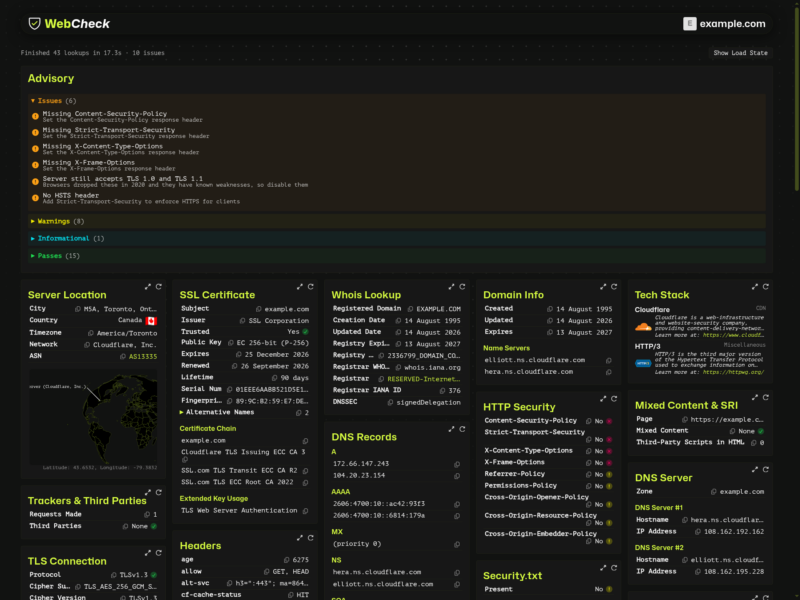
What Web Check does
Web Check runs more than forty lookups against any domain and shows what an attacker could learn before touching the site: the IP it resolves to, which network and city host it, the full certificate chain, DNS and TXT records, the cookies set on arrival and how tightly they are scoped, every HTTP response header, the redirect chain, reachable ports, the traceroute path, the TLS configuration and the frameworks in the tech stack.
It also grades the hygiene that usually gets left undone — Lighthouse scores for performance, accessibility, SEO and best practice, missing Content-Security-Policy or HSTS headers, mixed content and subresource integrity, DNSSEC and CAA records, a published security.txt, email authentication, malware and phishing reputation, breach history and even the carbon footprint of a page load.
How it works
Paste a URL and the checks run in parallel, streaming results into cards as each job finishes; a full pass takes around twenty seconds. An advisory panel groups the findings into Issues, Warnings, Informational and Passes so the things worth fixing rise to the top, and the same results are available through a JSON API for scripted or recurring checks.
Running your own instance
Web Check ships as a single container and is designed to be self-hosted, which keeps scan targets off someone else’s logs. It needs no database and no configuration to start; a handful of checks that depend on third-party services report as skipped unless you supply their API keys.
Good to know
It is a passive reconnaissance tool, not a scanner: it gathers published, publicly observable facts about a site rather than probing for exploitable flaws. Use it for a first look at your own domains, to catch hardening gaps before they ship, and to see what your stack already tells the world.