GuardianWAF
- Platform
- Linux macOS Windows Docker
- Licence
- MIT Open source
- Website
- guardianwaf.com
- Source code
- github.com/GuardianWAF/GuardianWAF
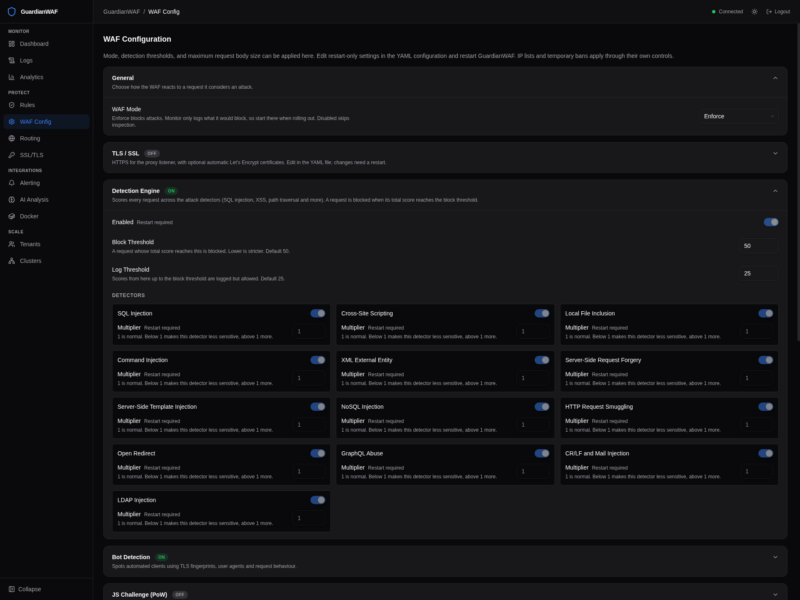
GuardianWAF is a self-hosted web application firewall written in pure Go with no external Go dependencies. It stands in front of any HTTP backend — Node.js, Python, Java, PHP, Ruby or .NET — as a standalone reverse proxy, a sidecar, or an embeddable middleware library, and inspects every request for common attack classes before the application ever sees it.
Detection
- Eleven detectors: SQL injection, cross-site scripting, path traversal, command injection, XXE, SSRF, server-side template injection, NoSQL injection, HTTP request smuggling, open redirect and GraphQL depth/complexity abuse.
- A tokenizer-based engine with configurable log and block score thresholds (the defaults block at 50 and log from 20) and per-detector multipliers.
- Rate limiting with a token-bucket algorithm, per-IP and per-path scoping, and automatic temporary bans.
- Bot detection through JA3/JA4 TLS fingerprints, user-agent analysis and behavioural tracking, plus an optional SHA-256 proof-of-work challenge that stops scripted clients while letting real browsers through.
- Response-side protection: security headers, credit-card, SSN and API-key masking, and stack-trace stripping.
- Optional AI review of suspicious events over 400+ model providers, with hourly and daily token caps so the bill stays bounded.
Reverse proxy
- Multi-domain virtual hosts with wildcard support, path routing, and round-robin, weighted, least-connection or IP-hash load balancing.
- Active health checks and a per-target circuit breaker, TLS termination with SNI-based certificate selection, hot reload and an ACME client for automatic certificates.
- Docker auto-discovery: label a container and the WAF finds it as a backend, pooling replicas that share a label into one load-balanced upstream.
- Frame-level WebSocket inspection, HTTP/2 support, and CEF or JSON export to a SIEM over TLS syslog.
Dashboard and operations
- A built-in React dashboard with a live event feed over SSE, attack analytics, a routing topology graph, IP ACL editing and live configuration toggles.
- A REST API for stats, events, config, routing and IP ACL, plus a Prometheus
/metricsendpoint behind the admin key and/livez,/readyzand/healthzprobes for Kubernetes. - An MCP server exposing 44 tools over stdio and SSE, for driving the firewall from a coding agent.
- Events kept in memory or in a file, up to 100,000 records.
Requirements
Nothing beyond the binary itself: releases cover Linux, macOS and Windows on amd64 and arm64, alongside an Alpine-based container image under 20 MB. A minimal configuration needs a listen address, an upstream URL and a route; the dashboard listens on port 9443 and is enabled in standalone mode.
Good to know
Configuration is YAML, and the dashboard only edits what can change at runtime — JS challenge and bot-detection modes are read-only in the UI and need a config edit plus a restart. The project is young (first release in 2026) and moving quickly: the dashboard expects the arrays it renders to exist in the config, so a minimal YAML without cors or ip_acl blocks shows an empty main view with a JavaScript error while the other pages still work — declaring those blocks as empty lists fixes it.
When this entry was written the prebuilt image would not pull anonymously from the project’s GHCR registry, while the published release binaries and the install script worked normally.