SkySend
- Platform
- Docker
- Licence
- AGPL-3.0 Open source
- Website
- skysend.app
- Source code
- github.com/Skyfay/SkySend
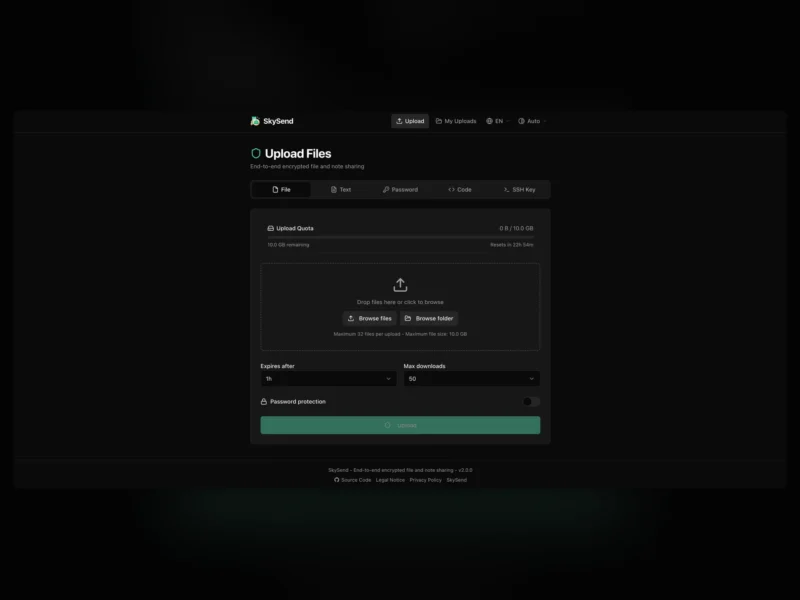
SkySend is a self-hostable file and note sharing service built around one promise: the person running the server cannot read what you send. Files and notes are encrypted in the browser with AES-256-GCM before they leave the device, and the key travels in the fragment of the share link — the part of a URL that browsers never transmit to a server. What lands in storage is ciphertext, so a zero-knowledge design is not a policy statement here but a property of the deployment.
What you can send
- Files and folders — one file, several at once, or a whole folder zipped in the browser, with per-share size and file-count limits you set on your own instance.
- Notes made of blocks — text, Markdown, a generated password, highlighted code and SSH keys can be combined into a single encrypted note rather than sent as separate shares.
- Requests in the other direction — hand somebody an upload link and the files or note they send back are encrypted for you alone, using HPKE (RFC 9180) so the server never holds a usable key.
- Shares that clean up after themselves — expiry times, download and view limits, and burn-after-reading, with an optional password on top of the link derived through Argon2id.
No accounts, unless you want them
There is no sign-up flow. The recipient needs only the link, and the sender’s “My Links” list lives in browser storage instead of a server-side profile. Where an instance does need to control who may share, optional OIDC sign-in gates that, which is the usual arrangement for an internal deployment. The project states no telemetry is collected.
Deployment and clients
A single Docker container with SQLite covers the standard case — mount a data directory and an uploads directory, set the base URL for your domain, and it is running on port 3000. Storage can be local or any S3-compatible bucket, images are built for AMD64 and ARM64, and the documentation covers reverse proxies and every environment variable. A CLI client with an interactive TUI performs the same encryption from a terminal, so uploads can be scripted. The interface ships in 13 languages with three themes.
Where it sits
SkySend credits two ancestors and is explicit about the difference: it is inspired by send, the community fork of Mozilla Send, and by PrivateBin, but written from scratch with a fuller crypto design and more features. That puts it in the same slot as Sharry in this directory — a small, purpose-built way to move something to another person over a link — but with the encryption enforced in the client rather than the server trusted. If the requirement is a general file cloud instead of one-off shares, the tools in this category like Filestash are the better starting point.