Amarok
- Platform
- Linux
- Licence
- GPL-2.0-or-later Open source
- Website
- amarok.kde.org
- Source code
- invent.kde.org/multimedia/amarok
Overview
Amarok is a free, open-source music player and collection manager from the KDE project, and one of the longest-running players on Linux: it was started in 2003, takes its name from a Mike Oldfield album, and borrows its wolf emblem from Inuit mythology. It is released under the GNU General Public License v2 or later, developed in the open at KDE’s GitLab, and distributed by every major Linux distribution as well as on Flathub. The current line is Amarok 3.x: 3.0 “Castaway” arrived in April 2024 after a six-year gap between major releases, moving the application to Qt 5 and KDE Frameworks 5. The 3.2 series is what Debian 13 “trixie” ships, and the 3.3 series carried the player onto Qt 6 and KDE Frameworks 6 — 3.3 “Far Above the Clouds” in July 2025, followed by 3.3.3, the third bugfix release of that series, in June 2026.
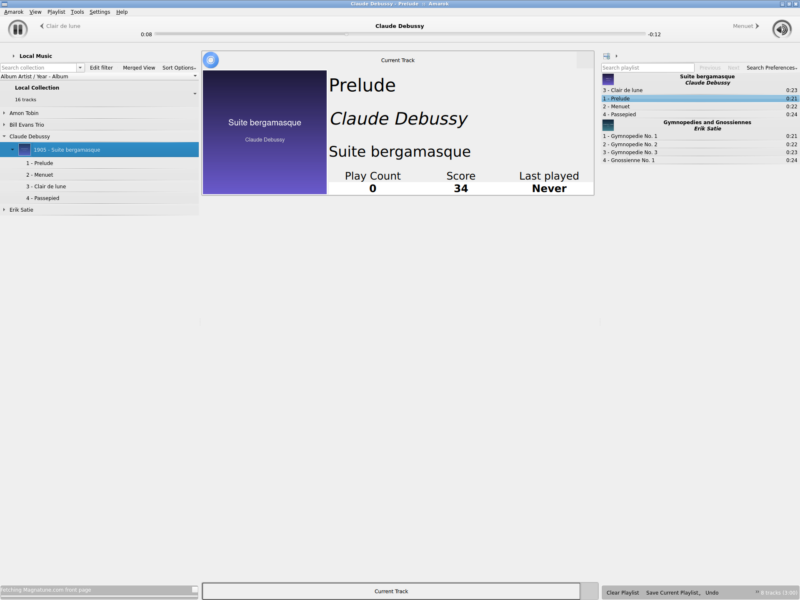
Amarok is not a one-window player. Its workspace is split into docks — a collection browser on the left, a context pane with the current track in the middle, and the playlist on the right — which can be resized, rearranged or closed, so the same application can behave like a compact player or like a full library tool. Everything is local by default: there is no account, no subscription and no cloud requirement, and the player is useful with the network switched off.
Key Features
- Collection management with ratings — browse a library of any size by album artist, year or album, rate tracks and filter the collection with the search box and the built-in filter editor. Statistics such as play count, score and last-played are kept per track.
- Dynamic playlists — playlists built from criteria rather than fixed lists of files, so the next track is chosen from your own collection to match what you asked for. Saved playlists and a playlist generator sit alongside them.
- Playlist workspace — tracks are grouped by album with durations and running totals, and the queue manager lets you push a request to the front without disturbing the rest of the list.
- Internet services — Last.fm scrobbling, Magnatune, Ampache, Jamendo and Librivox are built in as browsable sources, and podcast subscriptions are handled through OPML feeds.
- Portable players — basic support for iPod, MTP and UMS devices, so a player or phone can be browsed, filled and emptied from inside Amarok.
- Cover manager — fetch album art for the collection, assign covers by hand, and pick up a cover image stored in the album folder.
- ReplayGain — calculate and apply volume adjustment per track or per album, so a quiet recording does not disappear next to a loud one.
- Context applets — the middle pane can show the current track, lyrics, and Wikipedia pages for the artist or album while the music plays.
- Scripting support — the player exposes a scripting interface, so behaviour and extra services can be extended without patching the application.
- Graphic equalizer — a built-in equalizer for shaping the output when the recording or the speakers need help.
- Organise files — a rename-and-move tool that reorganises the collection on disk from tag patterns, with file tracking to keep the library consistent afterwards.
Why Use Amarok?
Most modern players treat a music collection as a folder to be played through. Amarok treats it as a library to be worked with: ratings and statistics feed the dynamic playlists, the context pane puts information about what you are hearing next to the music, and the collection browser is built for thousands of tracks rather than a dozen. It is also unusually hospitable for a KDE application — it runs on any Linux desktop, and the interface follows the system’s Qt style, so it does not drag a whole Plasma environment behind it. The 3.x releases matter for a practical reason too: the application was carried forward onto current Qt and KDE Frameworks releases, and distribution packaging came back with it — Debian dropped Amarok after the 2.x series and ships it again from trixie onward.
Use Cases
- Large local libraries — organised browsing, ratings, filters and dynamic playlists for collections big enough that file managers stop being useful.
- Desktop listening with context — lyrics and artist or album background in the same window as the player, without opening a browser.
- Portable player owners — fill an iPod, an MTP phone or a plain USB player from the same library that holds the desktop collection.
- Scrobbling and discovery — keep a Last.fm history and browse Magnatune, Jamendo and Ampache catalogues from inside the player.
Getting Started
Install Amarok from your distribution’s package manager — Debian 13 “trixie”, for example, ships Amarok 3.2.2 — or from Flathub as org.kde.amarok. On first start the player asks whether to use the music folder from your system settings as the collection folder; say yes and it scans, or point it anywhere else from the collection settings. No database server is needed: the collection runs on MariaDB embedded in the process, stored in your local data directory. Building from source uses CMake, Qt 5, KDE Frameworks 5 and FFmpeg development packages, and the repository carries instructions in INSTALL.
Alternatives
Strawberry is the most direct modern alternative and is itself a descendant of this family — it forked Clementine, which forked Amarok 1.4. Clementine and Exaile keep the older lightweight single-window approach, Elisa is KDE’s newer, deliberately simpler player, and Rhythmbox covers the same ground for GNOME users. Amarok remains the one built around a large, rated, filterable collection.
More players and music tools are collected in the music players category.