Sync-in
- Platform
- Docker Linux macOS Windows Self-hosted
- Licence
- AGPL-3.0-or-later Open source
- Website
- sync-in.com
- Source code
- github.com/Sync-in/server
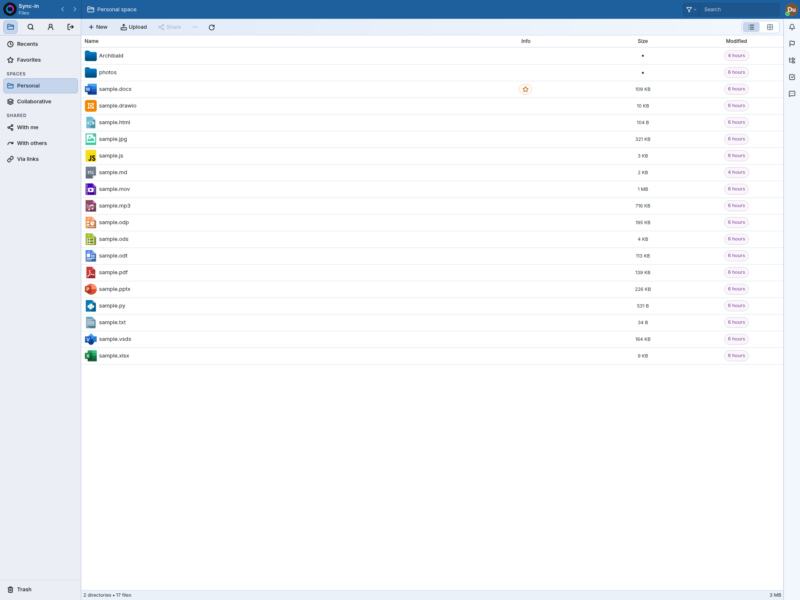
Sync-in is a self-hosted platform for file storage, sharing, synchronisation and team collaboration. It keeps files readable on the server’s own filesystem and layers collaboration on top only where it is needed, so a directory tree stays browsable with ordinary tools instead of disappearing into an opaque blob store. The result is a private cloud you can point at your own disks: web interface, desktop clients, WebDAV and a CLI all talk to the same server, and nothing leaves your infrastructure.
Files and sharing
- A web file manager with drag and drop, a smart clipboard, gallery view, sorting, filtering and previews for common document types.
- Spaces, shares, guest accounts, personal groups, roles and fine-grained permissions for controlled collaboration.
- Protected public links with access limits, expiry dates and passwords, plus activity tracking, comments, notifications and file locking.
- Storage quotas, trash retention, file protection tools and folder anchoring without duplicating data.
- Full-text search that indexes the contents of office and document formats, not just filenames.
Collaboration and clients
Online document editing works through Collabora Online, OnlyOffice, Euro-Office and draw.io, so spreadsheets, text documents and diagrams open in the browser without a local install. Synchronisation is available through WebDAV for network drives and third-party clients, and through official desktop and command-line clients for Windows, macOS and Linux with multi-server workflows. The interface is translated into more than 50 languages.
Authentication and access control
Accounts can be local, or delegated to OIDC or LDAP, and multi-factor authentication, recovery codes and application passwords are built in – useful when the server is reachable from the internet and needs to sit behind an existing identity provider rather than become another island of credentials.
Deployment
The server ships as a Docker image (syncin/server) and as an npm package (@sync-in/server), so it runs as a container next to its database or directly on a Node runtime. A public demo instance is documented at sync-in.com/docs/demo for a look before installing. Because storage stays on the filesystem, sizing is mostly a question of disk and the database backend rather than application memory.
Worth knowing
Online editing needs a separate document server (Collabora, OnlyOffice or similar) running alongside; without one, files can be stored, shared and previewed but not co-edited. If you need a mail, calendar and contacts stack in the same product, Nextcloud (the full collaboration suite with the largest app ecosystem); Seafile (a sync-first alternative with block-level deduplication); FileRun (a lighter file manager with WebDAV and mount support); ownCloud (the older enterprise-oriented sibling of the groupware stack). The project is AGPL-3.0-or-later with the desktop and CLI clients in separate repositories, and it is developed actively with frequent releases.