FOSS Face-Off: LimeSurvey vs Formbricks vs Fider — Best Open Source Survey & Feedback Tools
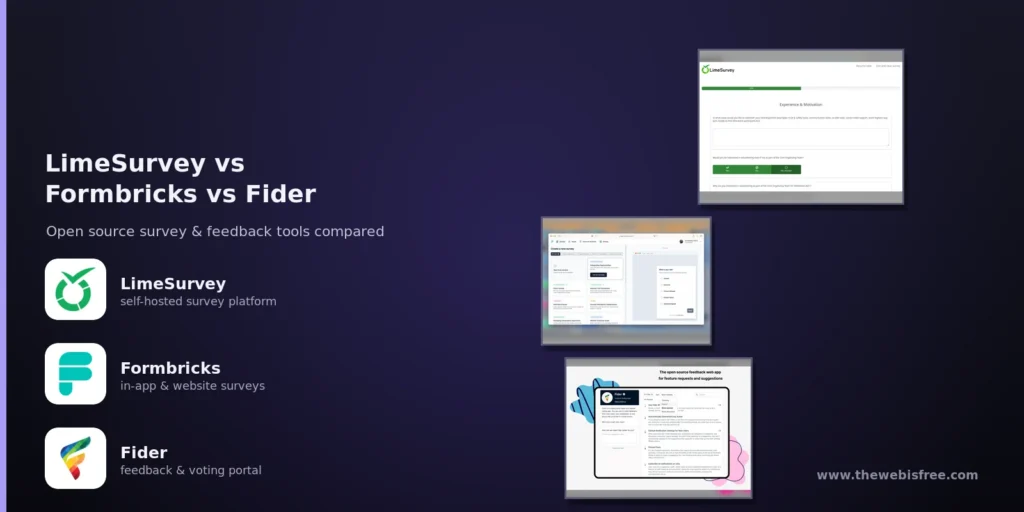
Collecting feedback from users quietly becomes a full-time project. A spreadsheet stops scaling, email threads go stale, and the really important idea — the one three customers mentioned — gets buried. Open source survey and feedback platforms fix exactly that: you host the data yourself, you own the responses, and nobody puts your customers behind a paywall. The catch is that “survey tool” and “feedback tool” are not the same job. LimeSurvey, Formbricks and Fider each solve a different slice of it, and picking the wrong one means fighting the tool instead of hearing your users.
LimeSurvey
LimeSurvey is the veteran of the trio. First released in 2003 and maintained by LimeSurvey GmbH in Hamburg, it is the tool you reach for when the survey is the project — a research instrument rather than a quick poll. The self-hosted edition is free software under the GNU General Public License, written in PHP with a MySQL or PostgreSQL backend, and it is genuinely the full product: you are not being funnelled towards a crippled community build.
- Question depth: Over 30 question types, including array, ranking, equation and file-upload questions, plus quotas, token-based participant lists and conditional logic and branching.
- Reach: Interfaces in more than 80 languages and a library of hundreds of ready-made survey templates.
- Analysis: Built-in statistics, exportable responses, and support for research techniques such as conjoint analysis and MaxDiff.
- Cost: Self-hosting is free with no user or response limits. LimeSurvey Cloud is a paid service that adds hosting, support and a choice of data-centre region.
In the directory: LimeSurvey listing — free to self-host, GPL-licensed.
Formbricks
Formbricks is the youngest approach here and it shows in the design: it is built for product teams who want to ask a question inside the product while the user is still using it. It is a TypeScript and Next.js application, and its privacy-first design makes it a strong fit for anyone with GDPR obligations, because every response can live on infrastructure you control.
- Where it asks: In-app surveys in web and mobile apps, website widgets, link surveys and email embeds — with targeting so a survey only appears to the cohort you care about.
- Targeting: Pre-segment by user attributes and fire surveys from triggers, so you can catch onboarding friction two weeks after sign-up or a churn risk at the billing screen.
- Licence: The core platform is open source under the GNU Affero General Public License; some packages are MIT-licensed, and a small set of enterprise features sit under a separate commercial licence.
- Cost: Self-hosting is free. The hosted cloud is a paid tier with per-response pricing.
In the directory: Formbricks listing — open source core, AGPL-licensed.
Fider
Fider is not a survey tool at all — it is a public feedback portal, in the tradition of UserVoice. Written in Go and backed by PostgreSQL, it puts a board in front of your community where anyone can post an idea, upvote someone else’s and comment. In a survey you ask; in Fider your users answer unprompted, and the vote count does the prioritising for you.
- Mechanics: Ideas with upvotes, comments, tags and statuses — so “planned”, “started” and “completed” become visible signals that people are being listened to.
- Reach: Search, optional social sign-in, email notifications, a REST API and webhooks for wiring ideas into your own workflow.
- Licence: Open source under the GNU Affero General Public License, with a genuinely free self-hosted edition.
- Cost: Self-hosting costs nothing; Fider Cloud is the paid managed option for teams that would rather not run Postgres themselves.
In the directory: Fider listing — free to self-host, AGPL-licensed.
Head-to-Head Comparison
Licence and cost
- LimeSurvey: GPL self-hosted, free with no limits; paid cloud available.
- Formbricks: AGPL core with a paid cloud; a few enterprise features are commercially licensed.
- Fider: AGPL, free self-hosted, generous community edition; paid cloud.
Survey depth
- LimeSurvey: By far the strongest — research-grade question types, quotas, tokens and advanced statistics.
- Formbricks: Solid for product and experience surveys, but scope is deliberately narrower than a research platform.
- Fider: No survey engine; feedback arrives as ideas and votes rather than structured questions.
In-app and embedded feedback
- LimeSurvey: Can be embedded in a page, but its heart is the standalone survey link.
- Formbricks: Purpose-built for this — in-app triggers, user-attribute targeting and email embeds are the core feature, not an add-on.
- Fider: Embedding is odd here; the board is meant to be visited, not injected into your product.
Roadmap and voting
- LimeSurvey: No voting model. Priority comes from your analysis of the responses.
- Formbricks: Some prioritisation through survey triggers and cohorts, but no public vote tally.
- Fider: The whole point — public upvoting, statuses and a visible roadmap that shows users you acted.
Self-hosting effort
- LimeSurvey: The heaviest lift: PHP, a database, and a longer configuration surface to learn.
- Formbricks: Container-friendly and quick to stand up, though the feature surface keeps growing.
- Fider: The lightest — a small Go binary and Postgres, up in minutes.
Which One Should You Pick?
Choose LimeSurvey if: you are running genuine research — longitudinal studies, segmentation, quotas or anything that will be cited in a report — and you need the question types and statistical tooling to do it properly.
Choose Formbricks if: you are a product team that wants to ask users questions in the moment, inside your own app, and keep every response on your own infrastructure.
Choose Fider if: you want a transparent, community-driven feedback board where your users vote on what you build next, in public.
The Bottom Line
There is no single winner, because the three tools are answering different questions. If you must pick one to start with, LimeSurvey is the most capable survey platform of the trio and the safest long-term bet for structured research. But the pairing that covers the most ground is Formbricks for in-product questions plus Fider for the public roadmap — one asks, the other listens, and both keep your data in your hands.
All three are free to self-host and open source. Find them alongside hundreds of other no-subscription tools in our full directory, browse the Polls, Surveys and Forms category, and if a project you love is missing, submit a tool.