Converse
- Platform
- Web Linux macOS Windows
- Licence
- MPL-2.0 Open source
- Website
- conversejs.org/
- Source code
- github.com/conversejs/converse.js
Overview
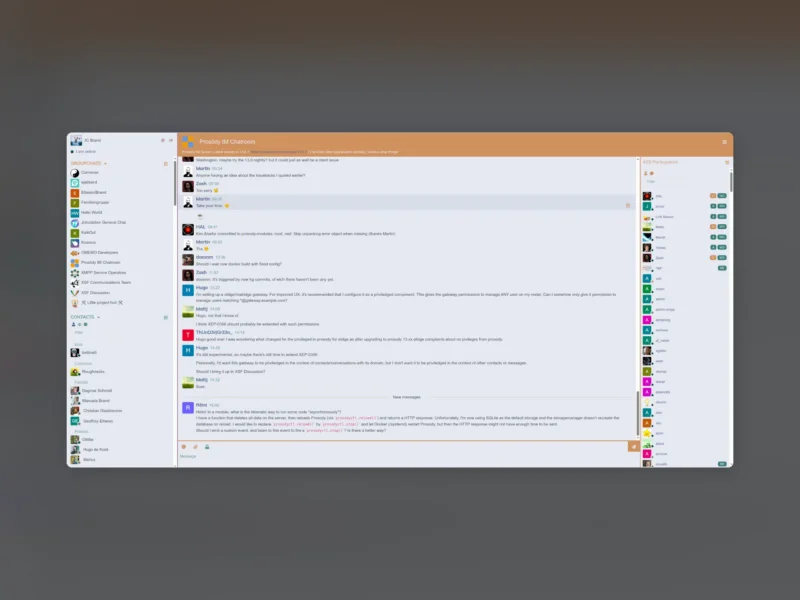
Converse is a modern, feature-rich XMPP chat client that runs in the browser. It is not a chat server: Converse is the front end you point at an XMPP account, so your messages stay on a server you choose rather than on a vendor’s platform. It can run as a standalone full-page web application, as floating overlay chat boxes on an existing site, or embedded as a single chat room in a page, and its headless core is published separately as @converse/headless for use outside the browser, including in Node.js.
It is one of the most protocol-compliant web clients available, implementing 75 XMPP extensions (XEPs) plus the core RFCs, which is why projects that already run Prosody, ejabberd or Openfire use Converse as their web interface.
Key Features
- Three UI modes: full-page application, overlay chat boxes, or an embedded component for one room
- Rich messaging: message styling, corrections, emoji reactions and URL previews
- End-to-end encryption: OMEMO for private conversations
- Audio calls: one-to-one calls over Jingle, since version 15
- Voice messages: record and send them through an opt-in plugin
- File sharing: HTTP File Upload support on servers that offer it
- Multi-user chat: group chat rooms with participant lists, roles and moderation
- Microblogging: follow and post to social feeds from the same client
- Presence and notifications: custom status messages, availability indicators and desktop notifications
- Extensible: a plugin architecture built on pluggable.js, translated into 40+ languages
- Responsive: usable on desktop and mobile browsers; official desktop builds are published for Linux, macOS and Windows
Why Use It
If you already run an XMPP server, or you want a chat client that is not tied to a single provider, Converse is the most complete browser front end for the protocol. Because it is a client, it slots into places a full chat platform would not fit: a support room embedded in a help page, a chat box in a WordPress site, or a live-chat widget next to a PeerTube instance. The same code base also ships as a desktop app if you would rather not keep it in a browser tab.
Use Cases
- Give an existing Prosody, ejabberd or Openfire deployment a modern web interface
- Embed a public support or community room in a website without a third-party widget
- Run overlay chat boxes next to other content on an intranet
- Encrypted one-to-one chat and audio calls between people who do not want a corporate messenger
Requirements and Caveats
Converse needs an XMPP account on a server it can reach over BOSH or WebSocket; the hosted demo at conversejs.org is for trying it out, and there is a demo page for anonymous login on servers that allow it. Self-hosting means building the bundle from source and serving the static files yourself, or using the ready-made server plugins for Prosody, ejabberd and Openfire. End-to-end encryption depends on the server and the other client supporting OMEMO, and file upload needs HTTP File Upload configured on the server side. Audio calls are one-to-one only; group calls are not part of the client. For a serverless alternative that needs no XMPP infrastructure at all, Chitchatter takes the opposite approach.