Databag
- Platform
- Web Linux Android iOS Docker
- Licence
- Apache-2.0 Open source
- Website
- github.com/balzack/databag
Overview
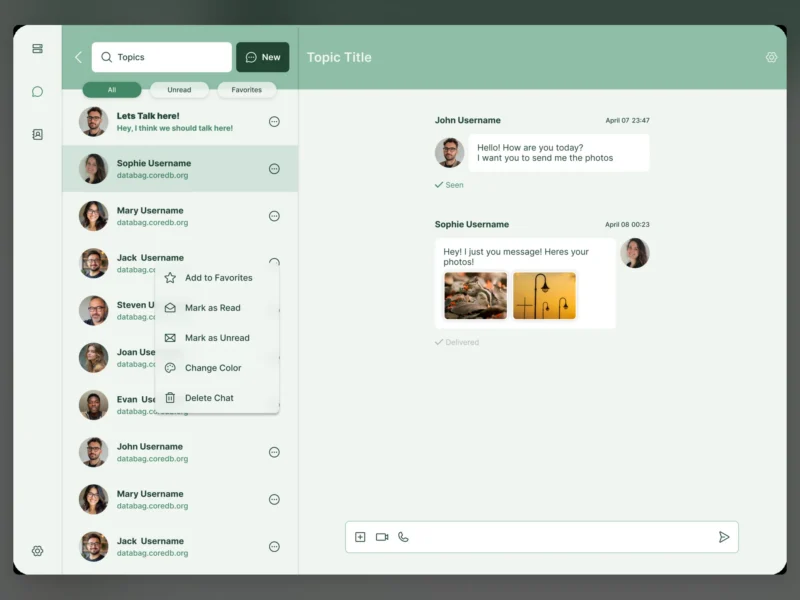
Databag is a self-hosted messenger built for small groups and federated from the ground up. An identity is a public–private key pair rather than an account tied to one hosting domain, so accounts on different nodes can message each other while each node keeps its own data. The server is a single Go binary with SQLite storage that runs on very modest hardware, and the same account is reachable from the browser client, the Android app and the iOS app.
How it works
Each person creates an account on a node and shares a profile link to be added as a contact; adding a contact opens a topic between the two accounts. Messages travel directly between client and server over WebSockets, and topics marked as sealed are end-to-end encrypted, so the person running the node cannot read them. Because identity is a key pair, moving to another node does not break existing conversations.
Features
- Topic-based threads instead of one-to-one inboxes, with no limit on participants in a topic
- End-to-end encryption on sealed topics; the admin cannot read sealed content
- Audio and video calls over WebRTC (NAT traversal needs a separate relay server)
- Unlimited accounts per node, so one node can host a whole household
- Push notifications for new contacts, messages and calls through UnifiedPush, FCM or APN
- Multi-factor authentication with TOTP apps
- Low latency from WebSocket push events rather than polling
- Small footprint: the server is documented as running on a Raspberry Pi Zero
Requirements and installation
The supported deployment is Docker, with arm64 and amd64 images on Docker Hub; a compose file is included and a second compose variant adds automatic TLS certificates through SWAG/certbot. A node needs a DNS name pointing at it with a valid certificate, which the federated model requires clients to trust. The admin password is supplied with the ADMIN environment variable on first start, and the admin dashboard at /#/admin generates the account-creation links, so the node owner decides who can join. The service listens on port 7000 by default and can also be run as a plain Go binary or under Portainer with Nginx Proxy Manager. Clients are a browser app, an Android app published on F-Droid and Google Play, and an iOS app on the App Store.
Who it is for
People who want to host chat for a family or a small community on hardware they already own, and who prefer a federated design over a single central server. It is not the right pick if you need large public communities, bridges to IRC or Slack, or a turnkey hosted service: this is a node you run yourself.
Alternatives
- Element — self-hosted group chat alternative
- Mattermost — self-hosted group chat alternative
- Rocket.Chat — self-hosted group chat alternative
- The Lounge — self-hosted group chat alternative