Rust
- Platform
- Linux Windows macOS Web
- Licence
- MIT or Apache-2.0 Open source
- Website
- rust-lang.org/
- Source code
- github.com/rust-lang/rust
Overview
Rust is a general-purpose, multi-paradigm programming language focused on performance and safety, especially safe concurrency. Created at Mozilla and now governed by the independent Rust Foundation, it guarantees memory safety without a garbage collector through its ownership and borrowing rules. That combination — C-like speed with compile-time protection against whole classes of bugs — has made it one of the fastest-adopted systems languages, now used in the Linux kernel, Android, Windows, Firefox, and services at AWS, Cloudflare and Microsoft.
Key Features
- Memory safety without a garbage collector — ownership, borrowing and lifetimes are checked at compile time, eliminating use-after-free, double-free and most data races.
- Zero-cost abstractions — high-level types, generics and iterators compile down to code as fast as hand-written equivalents.
- Fearless concurrency — the same rules make data races in threaded code a compile error rather than a runtime bug.
- Powerful type system and pattern matching — algebraic data types (enums) and exhaustive
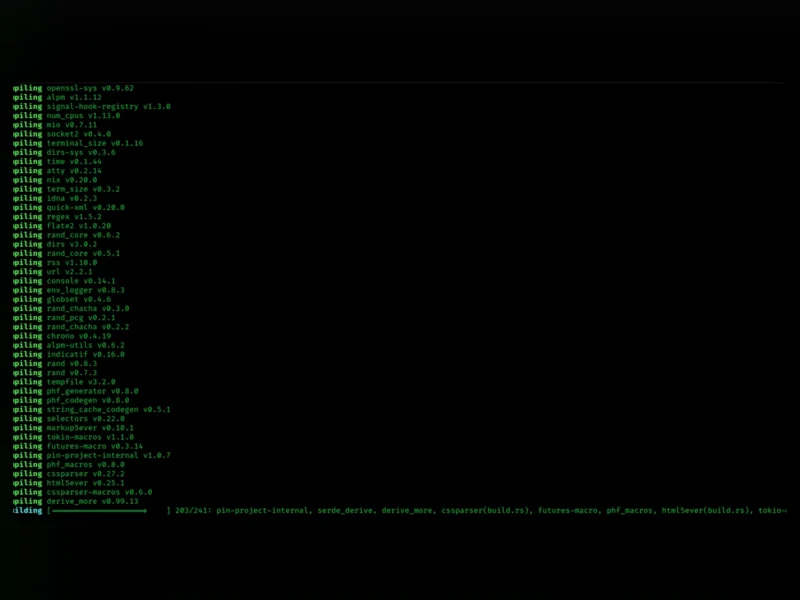
matchexpressions model problems precisely. - Cargo — an integrated build system, package manager and test runner with a large, curated crate ecosystem.
- Great error messages — the compiler explains problems and often suggests the fix, easing the learning curve.
- C interop — a mature foreign-function interface lets Rust call and be called by C, so it slots into existing codebases and libraries.
Why Use Rust?
Rust targets the exact space where C and C++ have historically been error-prone: low-level, high-performance software. You get native speed and no runtime overhead, but the compiler catches the memory and concurrency mistakes that account for a large share of real-world vulnerabilities. It is free and open source, developed in the open, and backed by a large, welcoming community with excellent official documentation (the “book”), so it is a practical choice for both new systems projects and hardening existing ones.
Use Cases
- Systems programming: operating-system components, drivers and embedded firmware.
- Fast, reliable command-line tools and developer utilities.
- Networked services and web back-ends, including high-throughput APIs.
- WebAssembly modules and browser components.
- Game engines, cryptography and other performance-critical libraries.
.