Elixir
- Platform
- Linux Windows macOS
- Licence
- Apache-2.0 Open source
- Website
- elixir-lang.org/
- Source code
- github.com/elixir-lang/elixir
Overview
Elixir is a functional, concurrent programming language built for applications that have to stay up. Created by José Valim and first released in 2012, it runs on the Erlang virtual machine — the BEAM — so it inherits more than three decades of Erlang’s work on fault tolerance, distribution and soft real-time performance, while adding a friendlier syntax and a modern toolchain. Data is immutable, processes are cheap, and failures are handled by isolating them in supervision trees instead of guarding every call by hand. Elixir is licensed under Apache-2.0, and the current release is 1.20.
Key Features
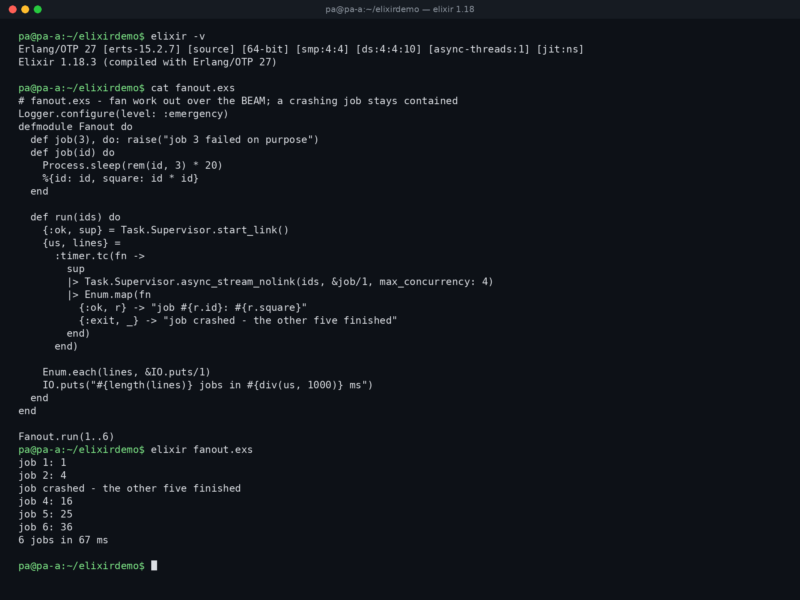
- Concurrency as the default — a BEAM process is a few hundred bytes with its own mailbox; a running application is thousands of them, scheduled preemptively across every core.
- Fault tolerance through supervision — processes are grouped under supervisors that restart them in a known state, the “let it crash” model that lets a service survive partial failures.
- Immutability and pattern matching — values cannot be changed in place, and function clauses destructure their arguments, so most code reads as a list of transformation rules rather than a sequence of mutations.
- Pipelines — the pipe operator threads a value through a chain of functions, so data flow reads from top to bottom instead of inside out.
- OTP included — GenServer, Supervisor, Agent, Registry, Task and ETS come from the platform itself, not a third-party library bolted on top.
- Metaprogramming that stays readable — macros are ordinary functions returning quoted expressions, which is how libraries such as Ecto build their query DSLs.
- One toolchain — Mix creates projects, resolves dependencies, runs tests with ExUnit and builds self-contained releases; Hex is the package repository.
- Ecosystem breadth — Phoenix for web applications, LiveView for server-rendered interactive interfaces, Ecto for databases and Nerves for embedded devices.
Why Use Elixir?
Elixir’s argument is the platform underneath it. Erlang was designed for telephone switches that could not go down, and the BEAM gives every application lightweight processes, preemptive scheduling, supervision trees and the ability to hot-swap code — properties that most runtimes still only approximate. Elixir makes that platform pleasant to use: a syntax closer to Ruby, pattern matching with immutable data, a package manager, a test framework and documentation tooling that work out of the box. The result is a language where a single server can hold hundreds of thousands of concurrent connections without a thread pool to tune, a failing component restarts instead of taking the system down, and deployments scale by adding nodes rather than re-architecting. The trade-offs are real: the functional style and OTP’s process model take deliberate learning, and the ecosystem, though healthy, is smaller than Python’s or JavaScript’s — teams that need a giant library catalogue for data science or desktop GUIs are usually better served elsewhere.
Use Cases
- Web applications and APIs with Phoenix, including real-time features over WebSockets and channels.
- LiveView interfaces that keep state on the server and push updates to the browser, without a separate JavaScript application.
- Messaging, telephony, IoT and presence systems — the workloads the BEAM was built for.
- Background job processing and data pipelines with Oban, Broadway and GenStage.
- Embedded and device firmware through the Nerves framework.
- Distributed systems and clustering, where nodes discover and coordinate with each other as a platform feature.
Getting Started
Install Erlang/OTP and Elixir together — the distribution packages (sudo apt install elixir on Debian and Ubuntu, brew install elixir on macOS) handle both, and Windows has an official installer. Check the pair with elixir -v, then start the interactive shell with iex, where expressions are evaluated as you type. Create a project with mix new demo and run its tests with mix test; add dependencies in mix.exs and fetch them with mix deps.get. The official guides at elixir-lang.org cover the language and OTP in order, and iex -S mix starts a shell inside a project so you can call your own modules while it runs.