Node-RED
- Platform
- Linux macOS Windows Docker
- Licence
- Apache-2.0 Open source
- Website
- nodered.org
- Source code
- github.com/node-red/node-red
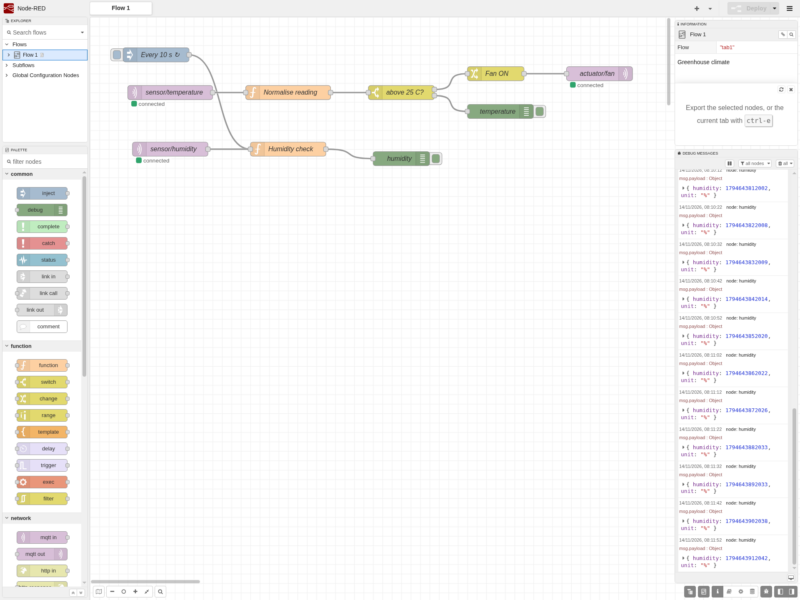
Node-RED is a flow-based programming tool for wiring together devices, APIs and online services, and it is one of the few automation tools where the program you write is a picture. The editor runs in a web browser, the runtime is Node.js, and a flow is a document of nodes joined by wires: inject a value, shape it in JavaScript, branch on it, publish it to MQTT, and watch the result in the debug pane. It began in 2013 as a side project of two IBM engineers, became a founding project of the OpenJS Foundation in 2016, and is released under the Apache-2.0 licence.
What it does
- Browser-based flow editor — drag nodes from the palette onto a canvas, wire an output to an input, and press Deploy. The same editor works from a laptop, a cloud VM or a Raspberry Pi over the network.
- Node.js runtime — the lightweight, event-driven runtime takes advantage of Node’s non-blocking model, so the same engine that handles a home sensor also handles a queue of HTTP events.
- A large node ecosystem — the Flow Library publishes more than 5,000 community nodes, installed with npm, which is why most integrations are a palette install rather than custom code.
- JavaScript where you need it — the function node gives a proper editor with library support for reusing snippets, while change, switch and template nodes handle the common cases without code.
- Protocol-level core nodes — MQTT in and out, HTTP and WebSocket, TCP, UDP and serial ports ship with the runtime, which is what made Node-RED a default choice for IoT gateways.
- Flows as JSON — every flow exports as JSON for a colleague, a forum post or the public Flow Library, and subflows and link nodes keep a large flow readable.
- Projects and Git — the built-in projects feature keeps flows under version control, with diffs and rollback, instead of the single flows.json file a plain install writes.
- Admin and multi-user access — the editor sits behind configurable authentication, so a shared instance can be exposed on a network without handing everyone the same session.
Deployment and requirements
The runtime is published to npm and runs on Node.js 22.9 or newer, so the shortest install is npm install -g --unsafe-perm node-red followed by node-red, with the editor on port 1880. An official container image, docker run -it -p 1880:1880 -v node_red_data:/data nodered/node-red, is the tidier option on a server, and prebuilt images exist for Raspberry Pi and other ARM boards. State lives in a data directory: nothing else is required, no database and no message broker, although most real installations add an MQTT broker and point the mqtt nodes at it.
Where it stands in 2026
Node-RED is at 5.0.9 (October 2026) with about 23.8k GitHub stars, maintained by Nick O’Leary and Dave Conway-Jones under the OpenJS Foundation, with FlowFuse as the sponsored commercial platform for enterprise deployments. The wiring model is its real distinction: a reader can open a flow and see the logic without reading code, which makes it a teaching tool as much as an automation one. It is less suited than a code-first framework when the logic is genuinely complex — a flow with hundreds of nodes is harder to review than a module of functions — but for glue between systems, scheduled jobs and device data it stays one of the fastest things to stand up.
Alternatives
- n8n — node-based automation aimed at SaaS APIs, with a far larger integration catalogue and a hosted option.
- Activepieces — MIT-licensed no-code automation with a business-app focus and a simpler editor.
- Kestra — declarative YAML orchestration for data pipelines, heavier but stronger on scheduling semantics.
- Huginn — Ruby agents that monitor the web and act on changes, older and quieter than Node-RED but still maintained.