Flow-Like
- Platform
- Linux macOS Windows Web Android iOS
- Licence
- BUSL-1.1 Source-available
- Website
- flow-like.com/
- Source code
- github.com/Rheosoph/flow-like
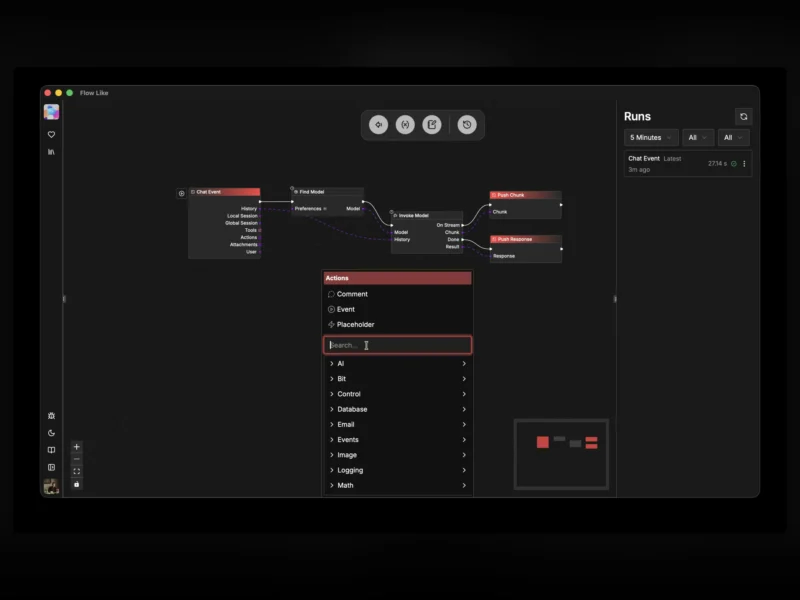
Flow-Like is a workflow engine that runs on your own hardware — laptop, server or phone — instead of in a vendor’s cloud. The engine is written in Rust and compiled to native code, and the editor is a no-code studio where nodes are wired together on a canvas with type-aware pins. Workflows can then be packaged as applications with their own storage and shared through a template store.
It sits in the same space as n8n and Node-RED but takes the opposite architectural bet: rather than a web server you host and reach over HTTP, you install a Tauri desktop app (or use the hosted web app) and the workflow executes locally on the device. That is what makes air-gapped, factory-floor and field deployments possible, and it is also why the project is licensed as source-available rather than open source.
Features
- A visual studio with smart wiring on type-aware pins, inline execution feedback, live validation and snapshot-based debugging
- Over 900 built-in nodes: APIs and webhooks, databases, file processing for Excel, CSV and PDF, AI models and computer vision, messaging for Slack, Discord and email, IoT, logic, and security
- Fully typed execution with recorded lineage — every input, transformation and output keeps its origin, and the same workflow can be read as a process, data or execution view
- Local or cloud AI: download and run LLMs, vision models and embeddings, with the model version and reasoning trace logged for each decision
- Apps and templates: package a workflow as a shareable application with storage, run it offline, or publish it to the template store
- Custom nodes through a Rust SDK
- Desktop builds for Linux, macOS and Windows, plus a web app; the mobile clients are still listed as coming soon
What to know before you use it
- Business Source License 1.1, not OSI open source. You may read, modify and run it, but the additional use grant forbids building a competing product or service with it, and companies with more than 2,000 employees or 300 million euros of revenue need a commercial licence. Each release converts to MPL 2.0 eight years after publication.
- The speed figures — roughly 0.6 ms per workflow against 50 to 500 ms for interpreted engines — come from the project’s own benchmark table. Read them as an indication of the design, not as an independent measurement.
- It is desktop-first by design: the local engine is the product. If you want a browser-managed server that other systems call over HTTP, a traditional self-hosted engine fits better.
- A hosted web app exists for trying it out, but the reason to pick Flow-Like is running it yourself.
Alternatives
n8n is the fair-code automation server most teams compare against, Node-RED is the event-driven flow tool for IoT and home automation, and Activepieces is the no-code option with an open core. Flow-Like trades their server-centric model for a native engine that runs where your data already is.