Dagu
- Platform
- Linux macOS Windows Docker
- Licence
- GPL-3.0 Open source
- Website
- dagu.sh
- Source code
- github.com/dagucloud/dagu
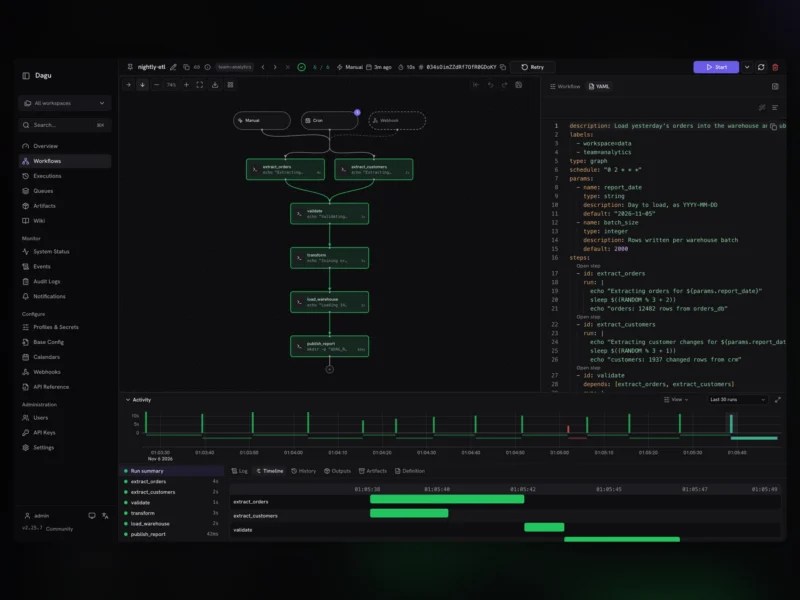
Dagu is a self-hosted workflow engine for teams whose real work is not orchestration. Workflows are declarative YAML files written next to the scripts they run, and a single Go binary executes them — with schedules, dependencies, retries, human approval steps and a built-in web UI — without a metadata database or a message broker. Steps can be shell commands, Docker containers, Kubernetes Jobs or remote commands over SSH, so the scripts you already have are not rewritten into framework code.
What it does
- Declarative DAGs — each workflow is one YAML file of steps with
depends:edges, which gives parallel branches and fan-in without a Python DSL or an SDK import. Delete the file and the scripts still run exactly as before. - Mixed executors — a step can be a shell command, a Docker container, a Kubernetes Job or a remote command over SSH, and one workflow can mix all four.
- Scheduling with real semantics — cron expressions with timezones, overlap policies (skip, queue or allow), catch-up windows and per-workflow concurrency limits, plus queues and resource limits that throttle the whole instance.
- Retries, notifications and history — per-step retry policies, notification hooks, and run history with per-step logs and status kept locally, so a failure at 03:00 is something you can read about in the morning.
- Human-in-the-loop steps — a workflow can pause and wait for a person to approve or reject before it continues.
- Reusable sub-DAGs — call one workflow from another and pass parameters, so a shared sequence lives in one place instead of being copied between jobs.
- Web UI and REST API — start, stop, retry and inspect runs in the browser, and drive the same operations from scripts through the documented API.
- Built-in MCP server — an MCP endpoint lets an AI agent inspect workflows and runs, maintain wiki pages, apply changes and control executions.
- Git sync — optionally keep the DAG directory in step with a Git repository, so workflow definitions are versioned like the code they run.
Deployment and requirements
One binary, and state lives in local files under a Dagu home directory — no external database and no broker to operate. Installer scripts cover Linux and macOS, with Homebrew, Windows Scoop, npm, a container image at ghcr.io/dagucloud/dagu and Helm charts as alternatives; the Docker quick start is docker run --rm -v ~/.dagu:/var/lib/dagu -p 8080:8080 ghcr.io/dagucloud/dagu:latest dagu start-all. That command runs the scheduler, the web server and the workers in one process, with the UI on port 8080. Scaling out is optional: additional workers can be pointed at the same home directory to spread execution across machines, and an experimental Go API allows embedding the engine in another application.
Where it stands in 2026
Dagu sits between cron and a full platform. Cron gives you schedules but no dependencies, retries or history; Airflow and Temporal give you those at the cost of operating an orchestration stack or moving business logic into an SDK. Dagu keeps the workflow as configuration and the engine as a single process, which suits ETL and data-operation scripts, media conversion with ffmpeg, legacy runbooks and internal automation on one machine or a small fleet. Development is active, with frequent releases and roughly 4.6k GitHub stars, and the project is GPL-3.0 with a separate note on commercial embedding of the Go API. The optional Dagu Console monitoring service is an opt-in, outbound-HTTPS, metadata-only extra; the engine itself runs fully self-hosted.
Alternatives
- Cronicle — distributed cron replacement with a web UI and multi-server scheduling, simpler but without dependency graphs.
- Kestra — declarative YAML workflow orchestration with a much larger plugin ecosystem, at the cost of a heavier stack.
- CTFreak — self-hosted task scheduler with SSH and WinRM remote execution, proprietary and freemium.
- Apache Airflow — the heavyweight choice when the pipelines really are Python code.