RapidForge
- Platform
- Linux macOS Docker
- Licence
- Apache-2.0 Open source
- Website
- rapidforge.io/
- Source code
- github.com/rapidforge-io/rapidforge
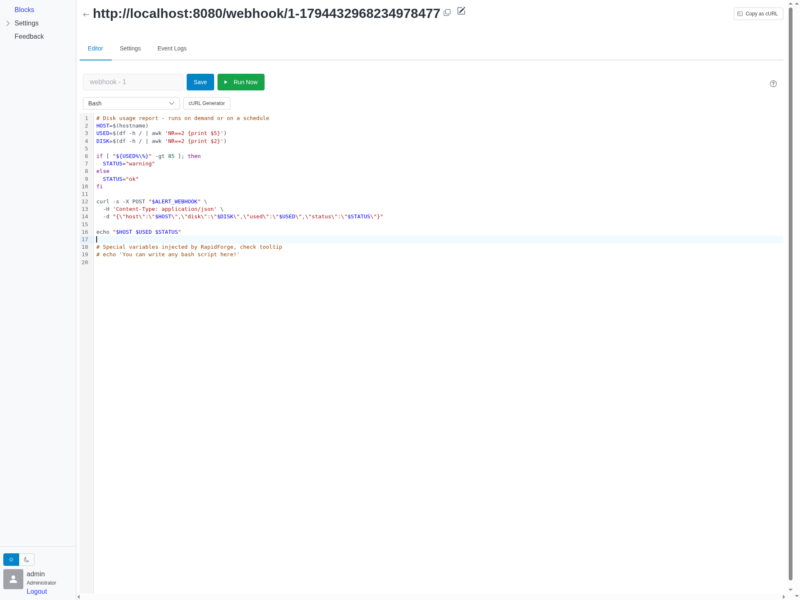
RapidForge is a lightweight, self-hosted platform for turning short scripts into HTTP endpoints, cron-style scheduled jobs and small web pages. Instead of standing up a full application to receive a webhook or run a nightly task, you create a block in RapidForge’s web interface, attach a Bash, Lua or mRuby script, and the platform handles the routing, authentication, scheduling and execution log around it.
What it does
- Webhooks and API endpoints — give a script a path and an HTTP method and you have a live endpoint. Each call records the request, its exit code, its response code and the response body.
- Scheduled tasks — the same block can carry a cron-like schedule, so one script serves both the trigger and the timer.
- Pages — a drag-and-drop editor for lightweight internal pages with embedded scripts, useful for a small dashboard or a form that drives a job.
- Event logs — per-block execution history, which is what tells you a webhook started failing silently at 03:14.
- Authentication built in — OAuth2 and bearer tokens, plus a cURL generator for the endpoint you just created.
- Environments and failure hooks — environment variables shared across a block, and a separate script that runs when the main one fails.
How it runs
RapidForge ships as a single Go binary with an embedded front end (HTMX and Shoelace components) and stores everything in SQLite, so there is no database to provision. Official builds cover Linux and macOS on x86_64 and arm64, and there is a Docker image. On first start it prints the generated admin username and password to stdout once, and you are expected to change the password after logging in. Lua ships as a bundled binary built with Cosmopolitan so it runs without native dependencies; if a system Lua is installed RapidForge prefers it. A built-in updater handles upgrades.
Because the data directory holds the SQLite file, that directory is the whole backup: mount it as a volume in Docker and copy it elsewhere.
Where it fits
RapidForge sits in the same space as Huginn, n8n and Node-RED, but takes a different bet: no node graph and no visual workflow, just a script behind a URL. If you already think in shell, that is less work than wiring integrations together, and the block stays readable in the terminal. If you want dozens of pre-built connectors, a script-first tool gives you nothing — you are writing the HTTP calls yourself.
Things to know
The project is young (first commits in mid-2024, still pre-1.0) with a small community, so expect the documentation and the rough edges of a tool that has not yet met many production setups. Scripts run with the privileges of the RapidForge process, so anyone who can edit a block effectively has shell access on that host: keep the instance off the open internet or behind its authentication and a reverse proxy. SQLite is fine for a personal or small-team install, and the wrong choice for a multi-tenant one.