AnyCable
- Platform
- Linux macOS Docker
- Licence
- MIT Open source
- Website
- anycable.io
- Source code
- github.com/anycable/anycable
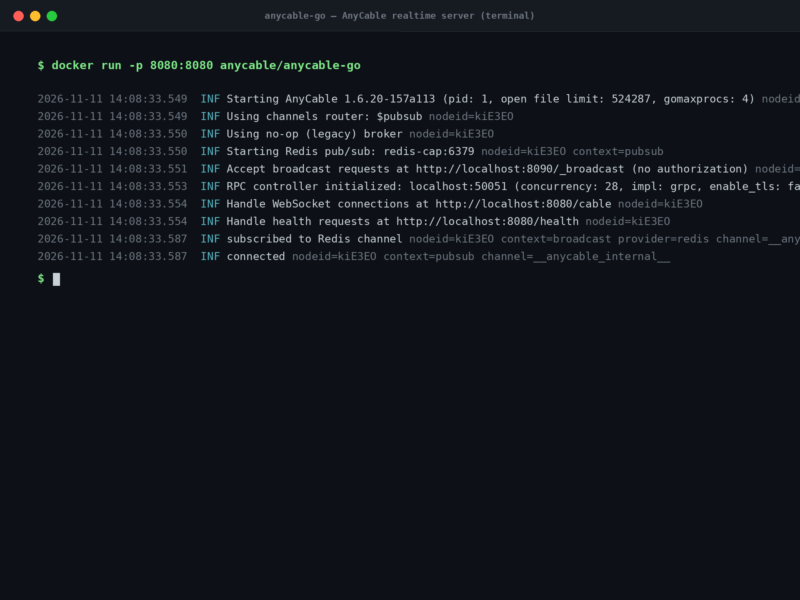
AnyCable is a realtime server for reliable two-way communication over WebSockets and Server-Sent Events, built and maintained by Evil Martians as a faster, language-agnostic replacement for the Action Cable server that ships with Ruby on Rails. The application keeps its existing broadcast code; AnyCable takes over the socket layer and the work of fanning messages out to connected clients.
How it works
- WebSocket endpoint at
/cableplus an SSE transport for clients that cannot hold a WebSocket open. - RPC controller (gRPC, with an mruby implementation available) where your own code authenticates connections and authorises channel subscriptions — so session logic stays in the application, not in the socket server.
- HTTP broadcast API at
/_broadcast, letting any process, cron job or third-party service push a message into a stream without opening a socket. - Pub/sub fan-out so several AnyCable nodes share one message stream; Redis pub/sub is the common choice and is what a default deployment connects to.
- Operational endpoints: a
/healthcheck for load balancers, structured logs with per-node IDs, graceful shutdown on SIGTERM and hot restarts without dropping clients.
Deployment and requirements
AnyCable ships as a single static Go binary (anycable-go) and an official Docker image, so the server itself runs on Linux, macOS or Windows and drops cleanly into a container platform. A deployment needs two neighbours: a pub/sub backend (Redis, or another supported adapter) and an RPC server — the AnyCable Ruby gem inside your Rails app, the mruby runtime, or a gRPC service you write yourself. Configuration is entirely through flags or environment variables; there is no database schema of its own.
When it fits
It is aimed at teams already running Action Cable-style broadcasting in Rails, Laravel, or a custom backend who have outgrown the default WebSocket server: many concurrent connections, several app instances behind a load balancer, or a need to push events from background workers. Because the RPC boundary is explicit, it also suits non-Ruby stacks that want a proven socket server with their own session logic behind it.
Licence
Open source (MIT). The edition described here is the open source AnyCable server. Evil Martians also sells a commercial Pro edition and a managed hosting service under the same name, which add features on top of the MIT code base.
More developer tooling is catalogued in the full directory.