Requestly
- Platform
- Web
- Licence
- AGPL-3.0 Open source
- Website
- requestly.com/
- Source code
- github.com/requestly/interceptor
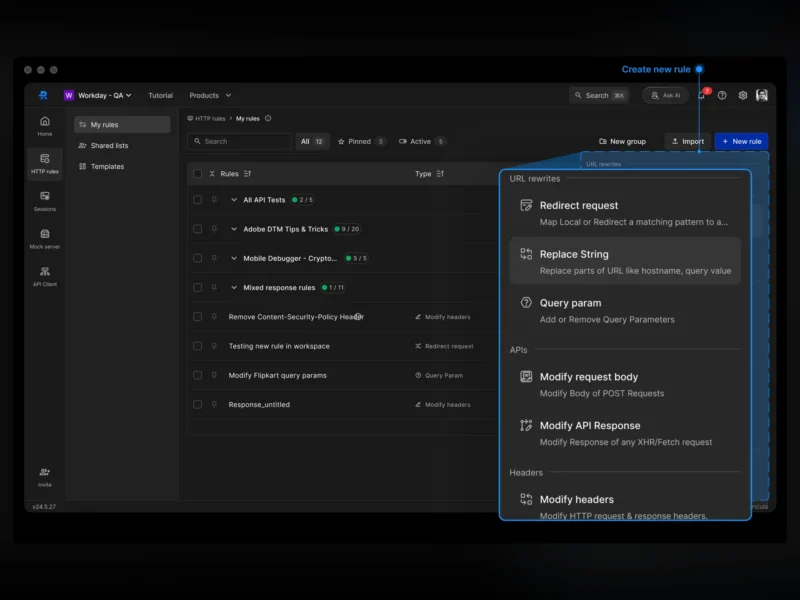
Requestly HTTP Interceptor is an open-source browser extension for Chrome, Firefox and Edge that lets you intercept and rewrite HTTP(S) traffic without a system proxy, VPN or a certificate dance. You define a rule once, and every matching request is redirected, rewritten or mocked before the page ever sees it.
It is the free-software half of the Requestly product line: the interceptor and its desktop proxy are published under AGPL-3.0, while the newer Requestly API Client sold alongside them is a proprietary application. If what you want is a Postman replacement, that part of the brand is not open source; if what you want is to bend HTTP traffic while you debug, this is the half to install.
What it does
- Redirect URLs — point a production API at staging or localhost by pattern, including regex and wildcard matching.
- Modify request and response headers — add, remove or override headers to test CORS, auth and cache behaviour.
- Override response bodies — replace an API payload with static JSON or a local file to reproduce an edge case in seconds.
- Map local and remote resources — serve a local file in place of a remote script, stylesheet or image.
- Inject scripts — run your own JavaScript in a page before or after the application’s own code.
- API mocking — stand up local or cloud-hosted mocks, target GraphQL requests, and generate mocks in bulk from a recorded session.
- Traffic capture — inspect requests and responses from browsers, mobile apps and desktop clients in a session log.
Where it fits
The everyday jobs are small and repetitive: redirect production traffic to a local build, simulate a failing or slow backend, swap third-party analytics during development, exercise feature flags without a redeploy, or drive mocks from Cypress, Playwright and Selenium runs. Because interception happens inside the extension, there is nothing to install on the machine beyond the extension itself; the separate desktop proxy exists for workflows that need to catch native app traffic.
Things to know
- The project reports 300,000+ developers using the interceptor. The extension is the mature part; the desktop proxy and the API client are newer.
- Rules can be shared with teammates through a Requestly account, but a purely local workflow needs no account.
- Some directories in the repository carry a separate enterprise licence, so a fully AGPL fork has to drop them.
Alternatives
For packet-level analysis rather than request rewriting, Wireshark covers the whole network stack and is the better tool once the question stops being “what did this request send” and becomes “what actually crossed the wire”. Teams that want their interception rules in version control usually keep them in a proxy config next to the code.