gpt-engineer
- Platform
- Linux macOS Windows
- Licence
- MIT Open source
- Website
- gpt-engineer.readthedocs.io/
- Source code
- github.com/AntonOsika/gpt-engineer
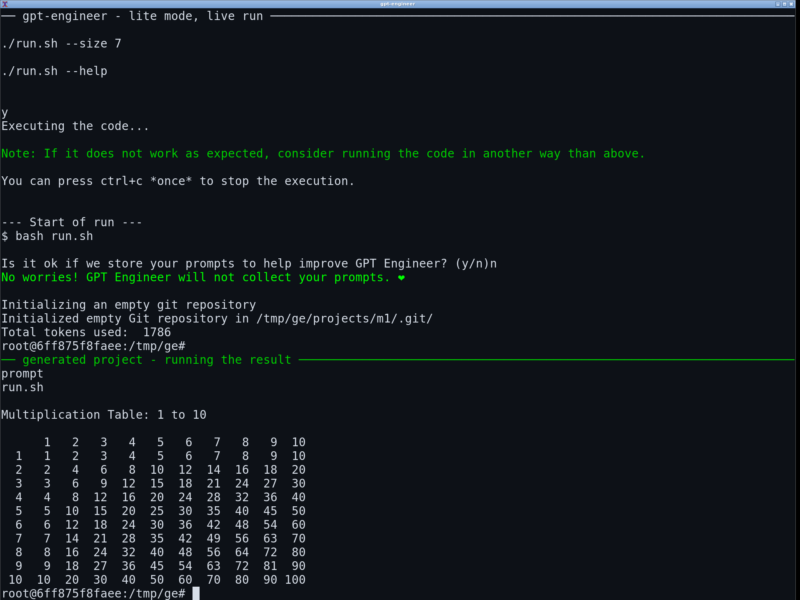
gpt-engineer is a command-line coding agent that turns a folder holding one plain-text brief into a working project. You create an empty directory, write a file called prompt describing the software you want, and run gpte projects/my-tool. The agent writes the files, generates a run.sh entrypoint for them, and then asks permission before executing what it produced — so the first time you see the program run is usually the moment it runs in your own terminal.
Read the status before you install it. The repository was archived in May 2025 and has had no maintenance since: no bug fixes, no security fixes and no new model integrations. The last release was v0.3.1 in June 2024, and the project describes itself in its own GitHub description as a precursor to Lovable. It still installs, still runs, and remains one of the clearer examples of a code-generation loop you can read end to end — but a new project should start with something that is still maintained.
Modes
- Default — one pass from the
promptfile to code, plus a generated entrypoint that installs dependencies and runs the result. - Lite (
--lite) — skip the intermediate spec step and go straight from the brief to files; the fastest way to see what the agent does with a small request. - Clarify (
--clarify) — discuss the specification with the model before any code is written. - Improve (
--improve) — point it at an existing checkout with apromptdescribing the change and let it edit the files it selects. - Self-heal (
--self-heal) — execute the generated code and feed failures back to the model until it runs.
Models and prompting
OpenAI is the default, Azure OpenAI is supported through --azure, and Anthropic models are used automatically when the model name contains claude. Because the CLI sits on an ordinary chat-completions client, any endpoint that speaks that API can drive it by pointing OPENAI_API_BASE at the endpoint and passing the model name with --model — during this review the CLI generated and executed a small project against a non-OpenAI endpoint without a code change. Local and other open models are covered in the project’s documentation.
The agent’s behaviour lives in editable preprompts: pass --use-custom-preprompts to keep a project’s own copies, which is how you make the agent hold a house style or a set of standing rules between projects. Vision-capable models can also be given an image folder with --image_directory (wireframes, architecture sketches), and --llm-via-clipboard swaps the API for copy-and-paste so the tool can be driven by a chat interface that has no API.
What a run leaves behind
The generated source, a README and a run.sh that creates a virtual environment before running the entry script; a git repository initialised in the project folder; and a per-project transcript of every model exchange under .gpteng/memory/logs, which is the practical way to see why it wrote what it wrote. A run ends by reporting the tokens it spent, so cost per attempt is visible without a separate dashboard.
Requirements and installation
Install from PyPI with pip install gpt-engineer on Python 3.10 to 3.12 — the package metadata excludes 3.13 — then provide a key through OPENAI_API_KEY or a .env file. The repository also ships a Dockerfile for building a container image, and a separate Windows readme covering WSL and native use. Nothing else is required: the generated projects carry their own dependency list, and the tool itself is pure Python.
Alternatives
- Aider — maintained terminal pair-programmer that edits an existing git repository instead of generating a new one
- OpenHands — a sandboxed software-engineering agent with a browser UI, actively developed
- SWE-agent — research agent tuned for fixing issues inside real repositories
- Continue — IDE-side assistant for in-editor generation and chat rather than whole-project scaffolding