Laravel
- Platform
- Linux Windows macOS
- Licence
- MIT Open source
- Website
- laravel.com/
- Source code
- github.com/laravel/laravel
Overview
Laravel is a free, open-source PHP web framework created by Taylor Otwell for building web applications with the model-view-controller pattern. The framework’s lower layers — the HTTP kernel, routing, console and event dispatcher — are Symfony components, while Laravel adds its own database layer, templating engine and developer tooling on top. It is “batteries included” by design: authentication scaffolding, database migrations, queues, scheduled tasks, mail, notifications and a REPL all ship with the default install, so a new project starts well past the empty folder.
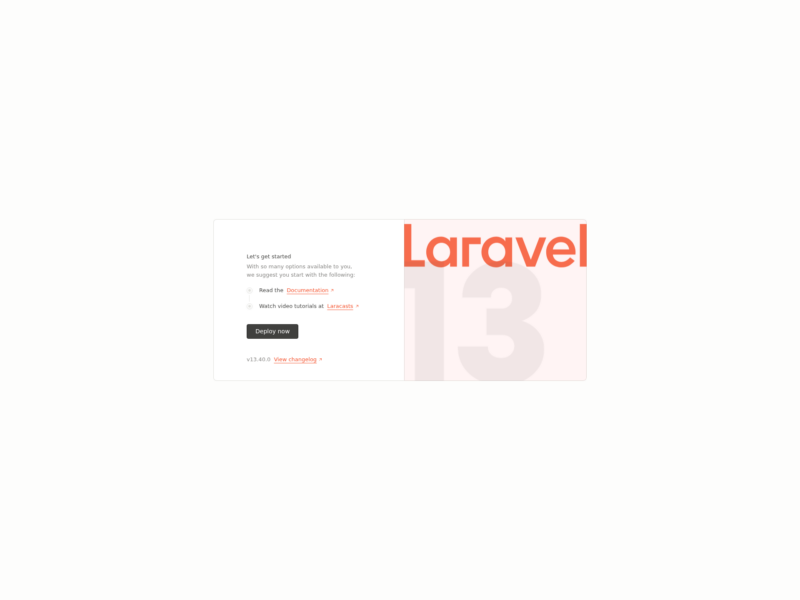
The current stable line is Laravel 13 (13.40.0 released in November 2026). New applications are created with Composer and require PHP 8.3 or newer; the default scaffold uses SQLite so it runs with no database server to set up, and MySQL, PostgreSQL, MariaDB and SQL Server drivers are supported when you need them.
Key Features
- Eloquent ORM — ActiveRecord-style models with relationships, eager loading, query scopes and model events; migrations and seeders keep the schema in version control.
- Blade templating — a template engine with inherited layouts, components and slots, and plain PHP as the escape hatch when a template needs it.
- Artisan console — the command line that generates models, controllers and migrations, runs database work, clears caches and starts a development server.
- Queues and the scheduler — background jobs and a cron-free task scheduler backed by the database, Redis, SQS or Beanstalkd.
- Authentication and authorisation — gates, policies and starter kits, plus Sanctum for API tokens and Passport for full OAuth2 when an API needs it.
- Testing built in — PHPUnit and Pest ship with the scaffold, with HTTP tests, database refreshing and fakes for mail, queues, events and storage.
- First-party tooling — Tinker (a REPL), Pint (code style), Pail (log tailing), Sail (a Docker development environment), plus optional Horizon, Telescope and Pulse for queues, debugging and monitoring.
Getting Started
A working install is two commands and one dependency: PHP 8.3+, Composer 2 and nothing else if you stay on SQLite.
composer create-project laravel/laravel my-app— scaffolds the application, generates the key and runs the initial migrations.php artisan serve— starts the development server on port 8000.
From there, application code lives in app/, routes in routes/web.php, templates in resources/views/ and migrations in database/migrations/. Laravel’s deployment documentation covers Nginx/Apache configuration, queue workers under a process manager and optimised autoloading for production.
Ecosystem and Alternatives
Laravel is the largest PHP framework by adoption and has an unusually wide first-party ecosystem: Forge and Cloud for server provisioning and hosting, Vapor for serverless, Nova for admin panels, and a commercial products catalogue that funds the open-source framework. It sits on the same PHP runtime as Symfony — in fact it is built from Symfony components — but the two take different positions: Symfony gives you decoupled components and wiring, Laravel gives you a complete, opinionated application stack. Teams that want a smaller footprint or full control of their architecture often pick Symfony; teams that want a working application quickly pick Laravel.
Browse more free and open source tools in the directory.