Tdarr
- Platform
- Linux Windows macOS Docker
- Licence
- Proprietary (Tdarr EULA) - free personal tier, paid subscriptions Freemium
- Website
- tdarr.io/
- Source code
- github.com/HaveAGitGat/Tdarr
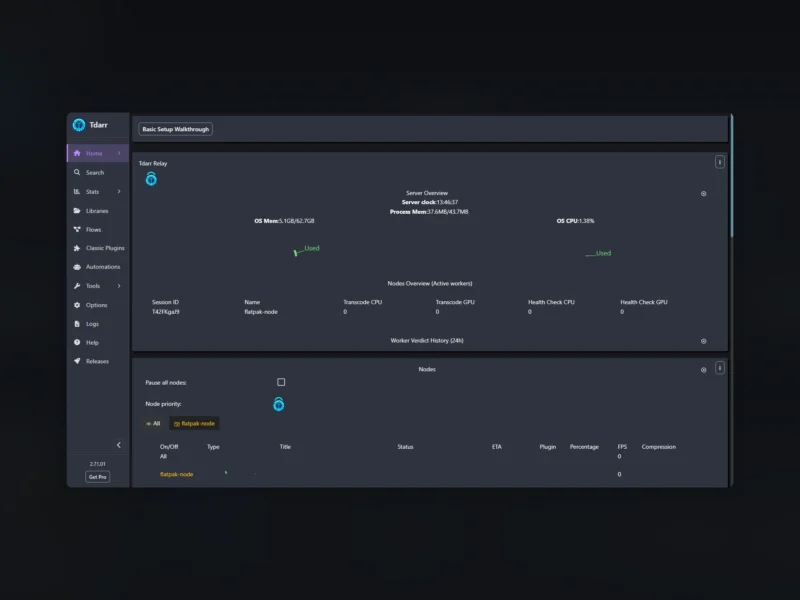
Tdarr is a self-hosted web application that automates transcoding and remuxing for audio and video libraries. A central Tdarr Server hands out work to one or more Tdarr Nodes, which run FFmpeg or HandBrake against your files according to the rules you set per library. The canonical use is converting h264 files to h265 (HEVC) to save 40-50% of the space, but the same conditional rules can remux containers, strip unwanted audio tracks and subtitles, and standardise codecs, containers and languages across a collection.
Key features
- Distributed workers: Tdarr Nodes run on Windows, Linux (including ARM and ARM64) and macOS, pulling tasks from the server so spare hardware becomes transcode capacity.
- Four worker types – transcode CPU, transcode GPU, health-check CPU and health-check GPU – with per-library worker limits and load balancing between libraries and drives.
- Plugin system for custom processing steps, with a community plugin repository.
- Seven-day, 24-hour scheduler plus a folder watcher, so libraries are processed off-peak and new files are picked up automatically.
- Video health checking: scan for corrupt or failing files rather than only re-encoding them.
- Property explorer and search, to find files by hundreds of properties (codec, resolution, bitrate, audio language) before deciding what to process.
- Library statistics and job reports, with a worker stall detector.
- Hardware transcoding through GPU workers, and workflows designed to sit alongside Sonarr and Radarr.
Why use it
Large libraries grow faster than disks, and re-encoding them by hand does not scale. Tdarr turns the job into a policy: describe the target for a library once (“h265, MP4, keep the English audio track”), and every file that arrives afterwards is judged against those rules and processed only if it fails them. Because nodes can run on any machine, an old desktop, a NAS or a machine with a supported GPU can be added without moving the files, and the scheduler keeps the heavy work away from the hours you actually watch things.
Things worth knowing
Tdarr is not open source. It is distributed under its own end-user licence agreement with a free personal tier for the server and nodes, plus paid personal and business subscriptions that unlock additional features; the current tiers and their limits are listed on tdarr.io. A working install normally means one server container (or native build) plus at least one node before anything is processed, and GPU workers need the vendor runtime, such as the Nvidia container toolkit or the unRAID Nvidia plugin. Jobs are real transcodes, so expect a machine to be busy for a long time on a large library – the point is that it runs unattended.
Use cases
- Shrinking an existing h264 library to HEVC to reclaim disk space.
- Normalising every file in a library to a fixed container, codec and audio profile.
- Health-checking a large collection for corrupt files.
- Spreading transcode load across several machines, with GPU acceleration where available.
Alternatives
- HandBrake – open source video transcoder and one of the engines Tdarr calls; the simplest option for one-off conversions.
- VidCoder – open source HandBrake-based transcoder for Windows with batch queueing.
- Unmanic – open source, plugin-driven library transcoder that covers much of the same ground without a proprietary licence.