yarr
- Platform
- Linux Windows macOS Docker Web
- Licence
- MIT Open source
- Website
- nkanaev.github.io/yarr/en/
- Source code
- github.com/nkanaev/yarr
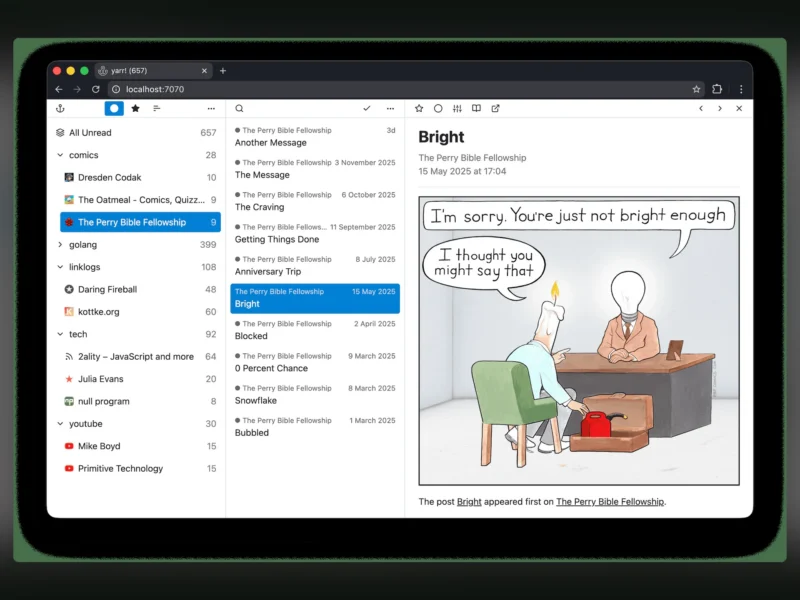
yarr (yet another rss reader) is a web-based feed aggregator written in Go. It compiles to a single binary with no dependencies, which means the same program works as a desktop app on Windows, macOS or Linux and as a self-hosted server behind Docker. Despite the small footprint it is a full reader: it stores articles in SQLite or Postgres, indexes them for full-text search, and serves a responsive interface that also installs as a home-screen web app.
Key Features
- Single binary, zero dependencies — One compiled Go executable. No PHP, Node or database server is required to get started; SQLite is the default store.
- Cross-platform — Windows, macOS and Linux builds, a Docker image and install scripts for the self-hosted route.
- Desktop app or self-hosted server — Run yarr locally as a desktop reader, or host it once and read from any browser.
- Responsive web UI — Layouts for desktop, tablet and mobile, plus PWA support so it can be installed on a phone home screen.
- SQLite or Postgres storage — Start with an embedded database, move to Postgres when the subscription list and archive grow.
- Four themes — Light, Beige, Night and System Auto, so the reader follows the operating system setting.
- Full-text search — Search across every stored article rather than only the visible feed.
- Keyboard shortcuts — Fast navigation between feeds and articles without touching the mouse.
- Readability engine — Strips page clutter and renders the article text for a clean local reading experience.
- Enclosure support — Podcasts, video and YouTube enclosures play inside the reader.
- Wide feed format support — Atom, RSS, RDF and JSON feeds, with OPML import and export for migrating subscriptions in and out.
- Background feed scheduler — Feeds refresh on their own; no external cron job to wire up.
- Fever API and REST API — The Fever-compatible API lets third-party mobile feed clients connect, and the REST API is there for scripting and automation.
- Private by design — Optional basic auth for remote access, HTTPS with custom TLS certificates, strict Referrer-Policy headers to block cross-site tracking, and content sanitisation for safe reading.
Why Use yarr?
Most self-hosted readers ask you to assemble a runtime first: a web server, a language stack and a database. yarr is the opposite — one file, one SQLite database, and a browser. That makes it unusually easy to try and unusually easy to keep running on a low-powered box, a small VPS or a Raspberry Pi, while still covering the features that matter day to day: search, keyboard-driven reading, podcast playback and a Fever API for phone clients. If you want a reader you can hand to a non-technical person without a deployment lecture, yarr is a strong fit.
Use Cases
- Personal RSS reader on a home server, NAS or Raspberry Pi
- Lightweight self-hosted replacement for Feedly or Inoreader
- Desktop feed reader on Windows, macOS or Linux from the same binary
- Podcast and YouTube subscriptions read alongside written feeds
- Feeding a Fever-compatible mobile client from your own server