Karakeep
- Platform
- Docker Web Self-hosted iOS Android
- Licence
- AGPL-3.0 Open source
- Website
- karakeep.app
- Source code
- github.com/karakeep-app/karakeep
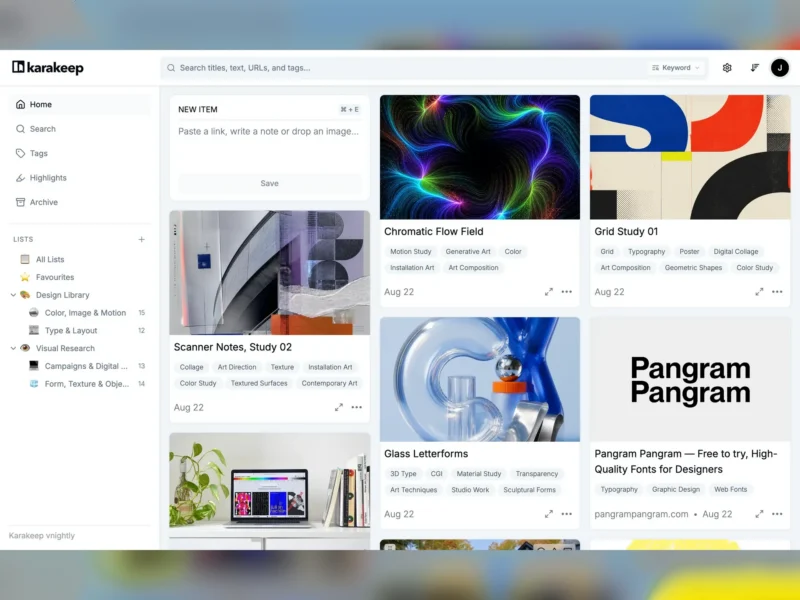
Karakeep is an open source “bookmark everything” app: you throw links, notes, images and PDFs at it, and it fetches each item’s title, description and cover image, keeps a copy of the page, and tags the item automatically using a large language model. It is the project formerly called Hoarder — renamed in 2025, with the code now at karakeep-app/karakeep and the site at karakeep.app, where the old hoarder.app domain redirects. It is written in TypeScript, published under AGPL-3.0, and has gathered roughly 30,000 GitHub stars since the repository was created in February 2024. The current release is v0.34.1 (22 October 2026).
Key Features
- Automatic AI tagging and summaries — every saved item is passed to a language model, which proposes the tags and writes a short summary, so nothing needs filing by hand. This is the feature that sets Karakeep apart from classic read-it-later apps, and it needs a model endpoint to work: an OpenAI API key, or a different provider such as a local Ollama instance
- Full-text and semantic search — everything you save is indexed, and the search bar switches between keyword, hybrid and semantic modes, so you can look for “the pasta recipe with the crispy garlic bits” rather than an exact phrase
- OCR for images — text inside screenshots and photographed pages is extracted and made searchable alongside everything else
- More than links — store links, plain notes, images and PDFs in the same library, all with tags, lists and search
- Lists and collaboration — group bookmarks into lists and invite other people in as editors or viewers, which makes it usable for a shared reading list rather than a single person’s drawer
- Reader view and highlights — saved articles open in a clean distraction-free reader, and passages can be highlighted and kept for later reference
- Archives against link rot — optional full-page archival (monolith) and automatic video archiving with yt-dlp keep the content even when the original page disappears
- Rules engine — define your own rules that fire when a bookmark is added and apply actions based on conditions such as a URL pattern, for example filing every Amazon link into a wishlist with a Shopping tag
- RSS in and out — subscribe to blogs and news sites and Karakeep saves new posts automatically, already tagged and searchable; any list can also be published back out as an RSS feed
- Clients everywhere — Chrome, Firefox and Safari extensions for one-click saving, native iOS and Android apps with offline reading, plus a web app and a REST API
- Built for agents — an official CLI, a first-party MCP server, scoped API keys and markdown-first content delivery make it straightforward for scripts and AI assistants to search and save on your behalf
- Importers and sync — bring existing collections across from Chrome, Pocket, Linkwarden, Omnivore or Tab Session Manager, and keep browser bookmarks in sync via floccus
Why Use Karakeep?
The older open source bookmark managers are filing cabinets: they store a link, a title and whatever tags you remember to add. Karakeep inverts that. You save first and the model does the organising, which means the library stays useful months later when you have forgotten what you called something. Semantic search covers the same gap from the other side — you can find an item by describing it instead of guessing its tags.
Everything else about it is designed for people who genuinely hoard: page archives so saved links do not rot, OCR so screenshots are not dead weight, RSS so new posts arrive without you clicking anything, and a rules engine so repetitive filing disappears. It is also one of the more actively developed projects in this space, with roughly 150 contributors and frequent releases.
Use Cases
- Research and reading lists — collect papers, articles and documentation while working, then find them again by meaning rather than by bookmark title
- Visual reference libraries — designers and illustrators can hoard images and screenshots, with OCR and AI tags making them searchable
- Recipes, ideas and personal notes — a single place for the links, notes and images you would otherwise lose in a chat thread
- Shared collections — a book club, a team reading list or a trip plan, curated by several people in one list
- Agent and automation workflows — the CLI, MCP server and scoped API keys let a script or AI assistant add and query bookmarks directly
Self-Hosting Karakeep
Self-hosting is the primary path, and the project treats it as a first-class citizen rather than an afterthought. Deployment is a Docker Compose stack on port 3000, following the compose file published in the repository; the only mandatory configuration is a handful of environment variables — NEXTAUTH_SECRET and MEILI_MASTER_KEY random strings, plus NEXTAUTH_URL pointing at your server. KARAKEEP_VERSION lets you pull the latest stable release or pin a fixed version for controlled upgrades, and full-text search runs on the bundled Meilisearch instance.
AI tagging is optional but recommended, and it is the one part that needs outside help: add an OPENAI_API_KEY to the environment file, or point Karakeep at a different provider such as Ollama if you would rather run the model locally and keep everything on your own hardware. A hosted cloud version also exists for anyone who does not want to run the stack. The code is AGPL-3.0 licensed, so the whole thing stays yours to inspect, modify and deploy.
Looking for more tools in this space? Browse our Bookmarks and Read-It-Later directory.