XPipe
- Platform
- Linux Windows macOS
- Licence
- Apache-2.0 (open core) Freemium
- Website
- xpipe.io
- Source code
- github.com/xpipe-io/xpipe
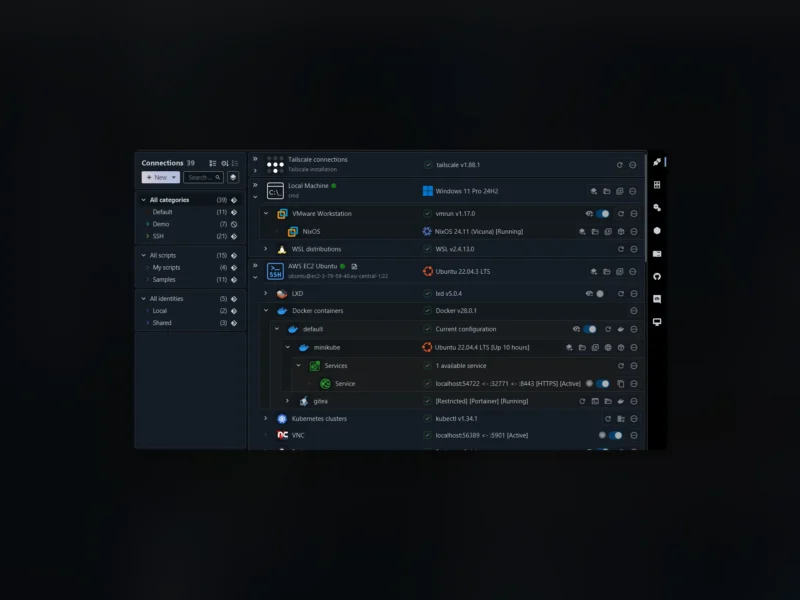
XPipe is a desktop connection hub for people who manage more than a handful of machines. Instead of keeping a bookmarks file of SSH hosts, a Docker context here and a hypervisor console there, it discovers the connections your tools already define — OpenSSH config files, Docker and Podman contexts, LXD and Incus remotes, kubectl contexts, Proxmox PVE, KVM/libvirt, Hyper-V and VMware inventories — and puts them in one searchable tree. From there a click opens a terminal, a file browser, a port forward or a container shell, using the terminal, editor and file manager you already run.
What it brings together
- Existing configuration, read in place. XPipe parses ssh_config, Docker contexts, kubeconfig, LXD remotes, VMware and Hyper-V inventories and your SSH keys, so there is nothing to re-enter and nothing to keep in sync by hand.
- Connections across the stack. SSH sessions, tunnels and port forwards; Docker and Compose, Podman, LXD and Incus containers; Kubernetes clusters, pods and services; Proxmox, KVM, Hyper-V and VMware virtual machines; RDP and VNC sessions; Tailscale, NetBird and Teleport links; AWS and Hetzner Cloud servers; PowerShell remotes; WSL, Cygwin and MSYS2 environments.
- Your tools, not new ones. Sessions are handed to the terminal, editor and file manager you already use — GNOME Terminal, iTerm2, Windows Terminal, Kitty, WezTerm, VS Code, IntelliJ — with a built-in terminal as the fallback when nothing else is installed.
- Scripts and a Git-backed vault. Scripts can be run against several hosts at once, and the encrypted connection vault can live in a Git repository so your definitions follow you between machines.
- Credential managers. Integrates with 1Password, Bitwarden, KeePassXC, SSH agents and hardware keys such as YubiKey, so passwords stay in the vault instead of inside the connection hub.
Nothing installed on the remote side
XPipe is a desktop client, not an agent: it shells out to the command-line tools already on your own machine (ssh, docker, kubectl, virsh, vmrun) and keeps its own data in an encrypted local vault that you unlock at start-up. Nothing is installed on the servers it reaches, which is what makes it usable against appliances and locked-down hosts where a management agent would never be allowed.
Requirements and caveats
Builds are published for Linux, macOS and Windows, and the standard installers bundle their own Java runtime, so no separate JRE is needed; Linux users also get a portable archive. A connection type appears only when the matching CLI tool is installed and on the PATH — no docker binary, no Docker section — and the GUI needs a normal desktop session, so this is not a headless server tool. XPipe is open core: the main application is open source under Apache-2.0, the free community tier covers personal use, and optional paid Homelab and Professional tiers add features such as unlimited hypervisors and advanced SSH options. The parts that implement those paid features, plus the shell-handling library, are not in the public repository.
Alternatives
XPipe is a local desktop hub. If you would rather reach your machines from a browser, Apache Guacamole and Nexterm are self-hosted web consoles, and MeshCentral adds fleet-wide device management.