Scanopy
- Platform
- Linux Windows macOS Web
- Licence
- AGPL-3.0 Open source
- Website
- scanopy.net
- Source code
- github.com/scanopy/scanopy
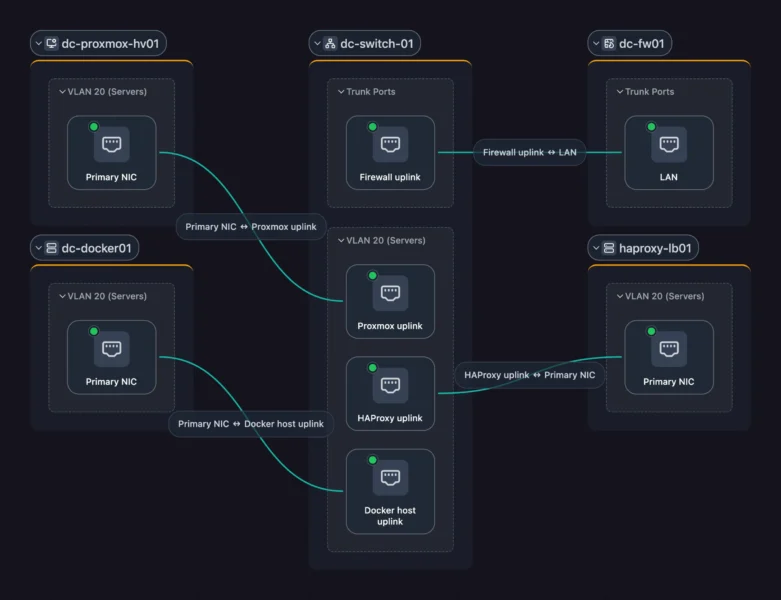
Scanopy is self-hosted network-documentation software that replaces hand-drawn diagrams with a model built from the network itself. A daemon scans the networks it can reach on a schedule and renders the result as four views: L2 (physical), L3 (logical), workloads and applications. Because every scan rebuilds the model, the diagram reflects what is connected now rather than what someone drew last quarter.
What Scanopy does
The problem it targets is familiar: network diagrams in draw.io or Visio go stale the week they are saved, and infrastructure-as-code state never sees the devices nobody provisioned through the pipeline. Scanopy starts from discovery instead — it walks the segments you point it at, reads switch and neighbour tables, and produces a topology that stays current after every scheduled scan.
Four views of the same network
- L2 (physical) — port-to-port links between switches and hosts, derived from LLDP, CDP and switch forwarding tables.
- L3 (logical) — subnets and how hosts connect across them.
- Workloads — VMs nested inside their hypervisor and containers nested inside the host.
- Applications — services and their dependencies, grouped by application.
Discovery and detail
- Service identification — several hundred service definitions recognise databases, web servers, printers, cameras and industrial protocols such as Modbus TCP, EtherNet/IP, OPC UA and BACnet from open ports, service responses and MAC vendor.
- VLANs and subnets — VLAN tables are read over SNMP and shown per port, native and tagged, with each VLAN linked to its subnets.
- No agent per device — a single scan daemon covers a segment; deploy more for more segments, each with its own schedule, rate and scope.
- Integrations — Docker, Podman, Proxmox VE, libvirt/KVM, UniFi Controller, Aruba Instant On, SNMP, SSH and gNMI, plus Wake-on-LAN.
Tracking and sharing
Each scheduled scan can send a digest listing new, stale and changed hosts, and snapshots freeze the network as of a date for audits and change windows. Views can be shared as read-only password-protected links with an expiry, embedded live in a wiki, or exported to image, document, diagram and wiki formats. Multi-user access control offers admin, member and viewer roles scoped per site.
Deployment
The quickest path is the project’s Compose file: bring it up, open the web UI on port 60072 and create the first account — the initial discovery starts on its own. The scan daemon itself runs on Linux, macOS, Windows or in Docker, so it can sit on each segment it needs to see. Scans need credentials or SNMP access for the switches you want mapped, and results — including topology and credentials — stay inside your own network.
Editions
The Community Edition is the full self-hosted product under AGPL-3.0. A Commercial Edition adds a commercial licence, more networks and seats, Confluence export, procurement paperwork and support, still on your own infrastructure; a hosted Scanopy Cloud is also offered.
Licence
Open source. GNU Affero General Public License v3.0 for the Community Edition; commercial editions are separately licensed.