NetBox
- Platform
- Web Linux Docker
- Licence
- Apache-2.0 Open source
- Source code
- github.com/netbox-community/netbox
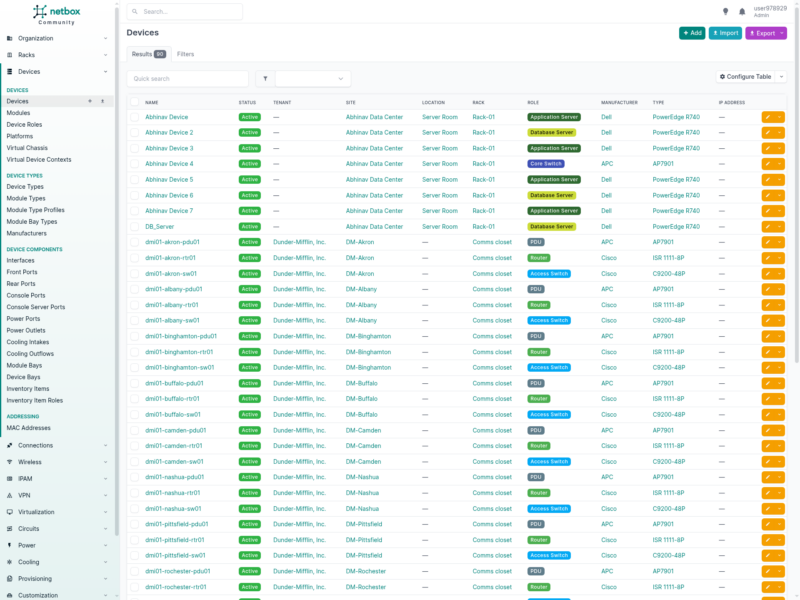
NetBox is a source of truth for network infrastructure: an inventory of what you actually own – racks, devices, cables, interfaces, IP addresses, VLANs, VRFs, circuits, power feeds and VPN tunnels – modelled in one inter-linked database instead of a pile of spreadsheets and a wiki page nobody has updated since the last office move.
It is not a monitoring tool and does not poll anything. The value is the data model: because every object is related to the others, you can start at a device and walk to the rack it sits in, the interfaces on it, the IP addresses assigned to those interfaces, the prefix those addresses belong to and the VLAN behind the prefix, and answer “what breaks if this switch goes down” without guessing.
What it models
- Organisation: regions, sites, locations, tenants and contacts.
- Hardware: racks and rack units, device types and manufacturers, devices, modules, interfaces, front and rear ports, console and power ports.
- Cabling: cable records with terminations on both ends, cable bundles and paths drawn from the physical model.
- Network: prefixes, IP addresses and ranges, VLANs and VLAN groups, VRFs, aggregate addressing, AS numbers and BGP-related objects through plugins.
- Power and physical plant: power panels, feeds, outlets, PDU tracking.
- Virtualisation and VPN: clusters, virtual machines, tunnel and IPSec models.
Built for automation
The data is meant to be consumed by other tools, not just typed in by hand. Everything in the interface is reachable through a REST API, and a GraphQL API is available for queries that need to pull several related objects at once. On top of that NetBox offers export templates, webhooks, custom fields and tags to extend the model, custom validation rules to stop bad records being written, and configuration templates rendered with Jinja2 from NetBox data – which is how a documented device turns into an actual device configuration for Ansible, Salt or a provisioning pipeline.
Plugins add whole new object types and views, which is how features such as BGP session tracking, DNS management or service catalogues end up in the same place as the hardware inventory.
Deploying it
NetBox is a Python/Django application backed by PostgreSQL and Redis. The community Docker image (netbox-docker) is the low-effort route and comes with a compose file for the application, database, cache and worker; Helm charts exist for Kubernetes; and the manual install is documented step by step from source. A migration path matters here more than for a stateless app – back up the database before upgrading between major versions, since schema changes are routine. NetBox Labs sells a hosted option and paid discovery, assurance and observability products around the open source core; the community edition this listing covers is complete on its own.
Alternatives
- Zabbix – monitors devices and collects metrics; it observes the network, NetBox documents it.
- phpIPAM – IP address management only, lighter than NetBox but without the device, cabling or rack model.
- RackTables – an older rack and IP documentation tool, largely superseded by NetBox’s data model.
- Nautobot – a fork of NetBox with a stronger app platform, driven by a different governance model.
- LibreNMS – discovery and monitoring with an inventory that is polled rather than curated.