LAN Orangutan
- Platform
- Web Linux macOS Windows Docker Self-hosted
- Licence
- MIT Open source
- Website
- lanorangutan.com
- Source code
- github.com/291-Group/LAN-Orangutan
LAN Orangutan
Website: lanorangutan.com
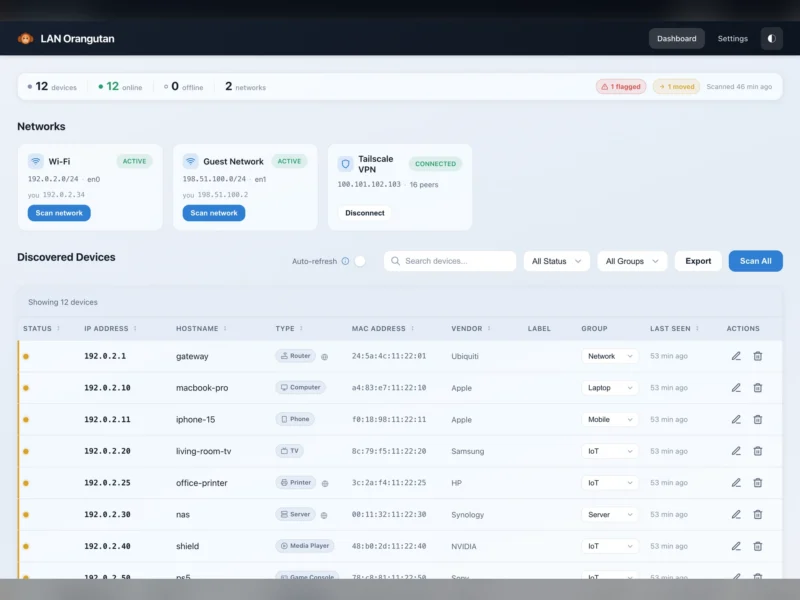
LAN Orangutan is a self-hosted network discovery tool for homelabs: it scans the networks you point it at with nmap, remembers every device it finds, and tells you what has changed. It is free and open source under the MIT licence, with no account or cloud service involved. Devices can be labelled, given a group and a location, and annotated; those choices persist across scans, so the same router does not come back as an unknown host the next day.
What separates it from a bare nmap wrapper is the bookkeeping. A device seen on both IPv4 and IPv6 is shown once, the scan also reads the machine’s ARP table so a host that ignores ping is still found, and snapshots let you compare the network against an earlier point. You can mark the devices you expect and get a webhook when something new appears, an expected device goes missing or an address moves. Tailscale peers are read from Tailscale itself and mixed into the same list. A single Go binary runs on Linux, macOS and Windows and needs only nmap alongside it; Docker is supported on Linux with host networking, but not on macOS or Windows, where the container sits behind a VM and cannot see the LAN, so run the binary directly there.
Key Features
- Device discovery: nmap scans plus ARP-table entries, covering IPv4 and IPv6, with a device found on both shown once.
- Persistent labels: groups, locations, notes, custom hostnames and device types you set by hand, kept when later scans run.
- Snapshots and comparison: save the current device list and compare it later, or with the live network, to see what is new, gone or moved.
- Change notifications: mark expected devices and send webhooks to Telegram, Discord, Slack, ntfy, Home Assistant or any endpoint that accepts JSON.
- Tailscale integration: see online tailnet peers alongside LAN hosts, and connect or disconnect Tailscale from the dashboard.
- Multi-network scanning: scan several subnets at once, including routed or VPN networks, with tighter timing applied automatically to remote links.
- CLI and REST API: the command line covers what the web interface does and can emit JSON, while token-authenticated API endpoints let scripts and dashboards read devices and trigger scans.
- Backup and reporting: export everything as one JSON backup, restore it, or generate a shareable self-contained HTML report of the network.
Licence
MIT. That permits use, modification and redistribution, including in commercial work, provided the copyright and permission notice are kept. The whole product is under that one licence.