WatchState
- Platform
- Docker Self-hosted Linux
- Licence
- MIT Open source
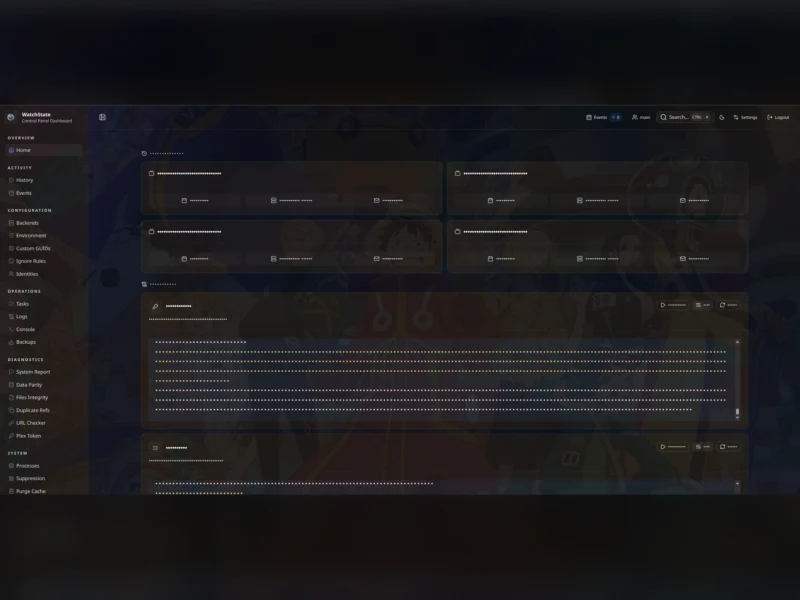
WatchState
Website: github.com/arabcoders/watchstate
WatchState is a self-hosted service that keeps play state — what you have watched and how far you got — in sync between Jellyfin, Plex and Emby. That matters when you run more than one media server: a migration where the old and new libraries coexist, a household split between Plex and Jellyfin, or a second server you use on the road. WatchState imports state from the backends you choose, stores it in a local SQLite database, and exports it to the others. It runs as a single Docker container on port 8080, does not send your history to a third-party service, and asks you to create the system user on the first visit.
What separates it from a one-button mirror is control over direction. Import and export are separate switches on each backend, so Plex can be the source while Jellyfin is the target, or both can feed each other many-to-many. It also works as a backup tool: with a single backend enabled you can keep an independent copy of every user’s play state and push it back to a replacement server after a failure. WatchState is free and MIT-licensed, with no paid tier; the optional webhook integrations do depend on features of the media servers — Plex Pass for Plex, Emby Premiere for Emby — rather than on WatchState itself.
Key Features
- One-way and many-to-many sync: enable import and export independently for each backend, so you decide which server is authoritative instead of accepting a guessed merge.
- Webhook updates: receive play, pause and stop events from the media servers at a single generic webhook URL that covers all users and backends; the project recommends keeping scheduled imports running too, because webhooks can be missed or delayed.
- Scheduled tasks: the import task runs hourly by default and export runs hourly at 30 minutes past the hour, with the cron expressions editable in the environment settings.
- Multi-user identities: match accounts across backends and provision identities per user; WatchState describes itself as primarily single-user, with identity support built on top.
- Backup and restore: automatic backups from the Backups page, a portable export of backend play state, and a force-export operation to push local state back to a backend.
- Media Health: audit the database for conflicting external IDs, duplicate records, metadata disagreement between backends, weak matches and, optionally, missing files.
- Statistics and metadata search: view local user statistics and export them as Markdown or JSON, and search the metadata held by your backends.
- Path matching: match items by local media path as well as external IDs, so libraries whose identifiers differ can still line up.
Licence
MIT. You can run, modify and redistribute WatchState, including commercially, as long as the copyright notice is kept. There is no paid tier; the maintainer asks for charity donations instead.