Koito
- Platform
- Docker Self-hosted Web
- Licence
- MIT Open source
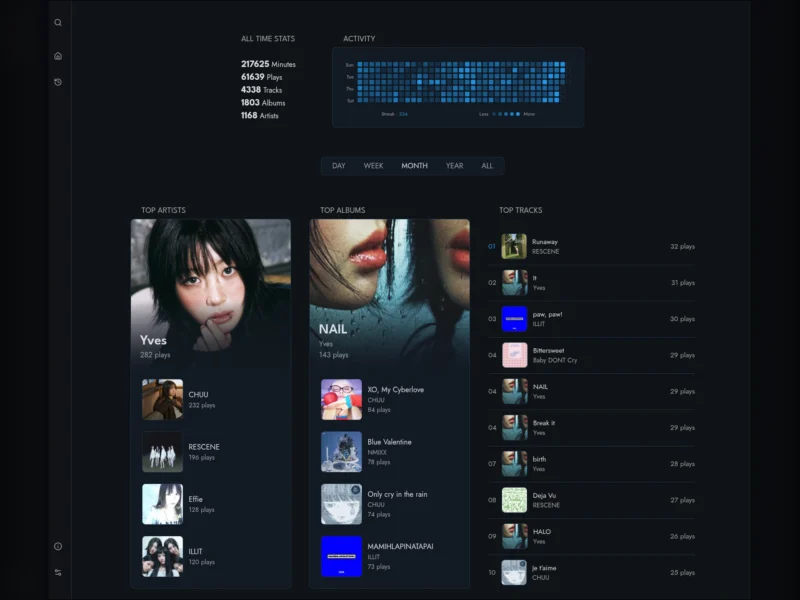
Koito
Website: koito.io
Koito is a self-hosted scrobbler: it records the tracks you play and turns them into listening statistics you own. It speaks the ListenBrainz API, so a music server or phone app that can scrobble to a custom ListenBrainz URL can send its listens to Koito instead. It is free and open source, funded through donations rather than a paid tier.
The obvious alternatives are Last.fm, which holds the data, and ListenBrainz, which is a public service. Koito runs on your hardware, keeps everything in a single SQLite database and adds a dashboard for totals, streaks and top artists, albums and tracks. It can also relay every listen it receives to another ListenBrainz-compatible server, so you can run it alongside an existing scrobbler rather than replacing it on day one. A Navidrome library can scrobble to it directly.
Key Features
- ListenBrainz-compatible API: Point clients at
/apis/listenbrainz/1and use the API key Koito generates in its settings; Navidrome and other ListenBrainz-compatible clients all work this way. - Scrobbler relay: Set the relay environment variables and Koito forwards incoming listens to another ListenBrainz-compatible server, so a new instance can run alongside your current setup.
- Import your history: Bring in existing data from Spotify’s extended streaming history, Maloja exports, Last.fm exports and ListenBrainz export files.
- Automatic metadata and artwork: Koito fetches release data from MusicBrainz and images from Deezer and the Cover Art Archive, with optional Last.fm and Subsonic sources for covers.
- Listening dashboard: All-time totals for minutes, plays, tracks, albums and artists, an activity heatmap with a current streak, and top artists, albums and tracks for day, week, month, year or all time.
- Twelve themes: Ships with twelve built-in themes and supports custom themes; the default can be set per instance from the configuration.
- Library editing: Change aliases, MusicBrainz IDs and artist associations, replace artist or album images by dragging a file or giving a URL, and merge duplicate items so their listens move to the entry you keep.
- Small footprint: A single Docker image on port 4110, configured through environment variables, with all state in SQLite, which the project has used for new installs since v0.2.1.
Licence
MIT. You can run, modify and redistribute Koito, including inside a commercial setup, provided you keep the copyright notice; there is no warranty. There is no paid tier, so the free version is the whole product.