Jelu
- Platform
- Docker Self-hosted Web
- Licence
- MIT Open source
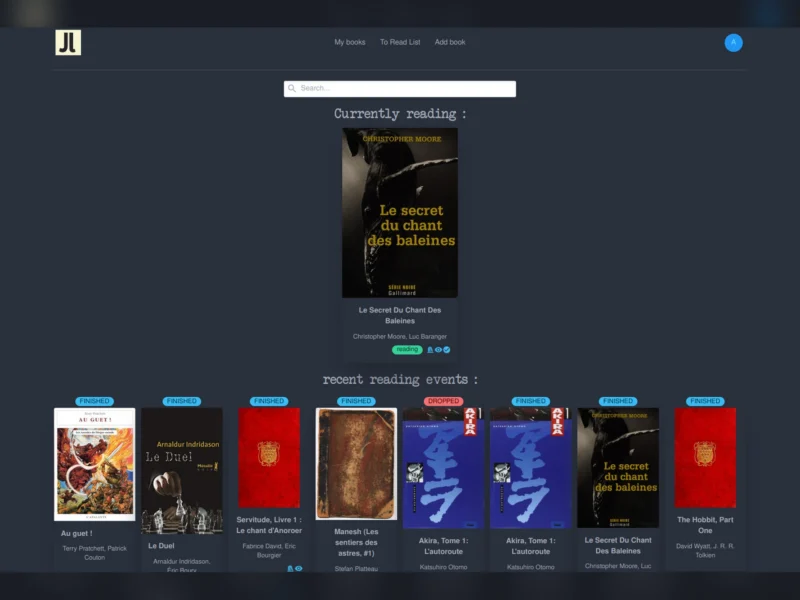
Jelu
Website: github.com/bayang/jelu
Jelu is a self-hosted reading log: a place to record the books you have read, the one you are reading and the ones you want to read next. The author describes it as a personal Goodreads, built after losing data to services that shut down and to repeated exports and reimports. It runs as a Java jar or a Docker container, keeps everything in a single SQLite database you can copy, and exposes a REST API rather than locking your history inside a web page. It is MIT-licensed and free to use, with no paid tier or hosted upsell.
What separates Jelu from a spreadsheet is that the reading record stays queryable. Tags are a first-class part of the model, so the same book can sit on a genre shelf, a summer-2022 shelf and a shared to-read list without being duplicated. Metadata can be fetched from several providers with a fallback order, and the interface exposes reviews, quotes and embed snippets that can be shared without opening the rest of your instance. It is a tracking tool rather than an ebook library: covers, metadata and reading events are what it stores, not the text of the books.
Key Features
- Read and to-read tracking: mark books as reading, finished or dropped, and view a history broken down by year and month.
- Goodreads and ISBN imports: bring in an existing Goodreads CSV export or a plain list of ISBNs, one per line; imports run in the background, and the library can be exported back to CSV.
- Metadata providers with fallbacks: fetch book data through calibre’s fetch-ebook-metadata binary, Google Books (with your own API key), Inventaire or Databazeknih, and change the plugin order per request.
- Tags, shelves and custom lists: tags are shared at instance level; shelves pick out the tags shown on the home page, and custom lists collect every book carrying a chosen set of tags, with public and actionable options.
- Reviews and quotes: rate a book from 0 to 10 in half-point steps, write a review or save a quote with a page position, and choose private or public visibility; a public link exposes that page only.
- Multi-user access: create several accounts, give each user a library, and authenticate through LDAP, a reverse proxy or local accounts.
- Scoped API tokens: use Basic auth or bearer tokens limited to scopes such as books:read, reading:write and import:write for scripts and third-party tools.
- Author pages and statistics: browse an author’s books, pull a biography from Wikipedia, merge duplicate authors, and see all-time and yearly reading counts.
Licence
MIT. You can run, modify and redistribute Jelu, including commercially, provided the copyright notice is kept. There is no paid tier; the project accepts donations through Ko-fi.