RunsOn
- Platform
- Self-hosted
- Licence
- Commercial Freemium
- Website
- runs-on.com
- Source code
- github.com/runs-on/runs-on
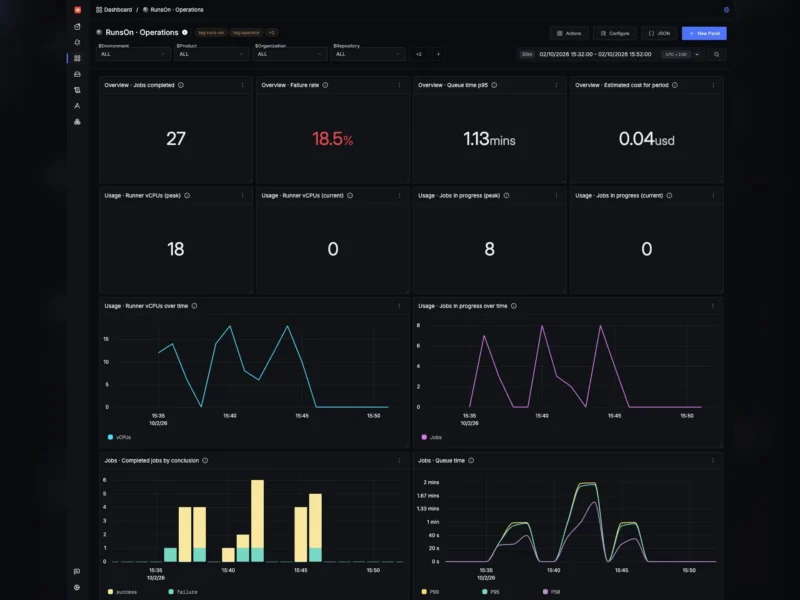
RunsOn is a self-hosted control plane for GitHub Actions that launches a fresh, isolated EC2 runner for every job inside your own AWS account. Instead of a Kubernetes cluster plus an autoscaler, you deploy one CloudFormation stack (or the Terraform/OpenTofu module) and RunsOn starts runners on demand, scaling back to zero when the queue empties. IAM, networking, runner images, caches and the AWS bill stay under your control, and no execution plane of the vendor sits in the job path.
How it works
Runners are ephemeral by design: each job gets a clean machine built from GitHub’s own runner images (refreshed roughly every 15 days), so existing actions and toolchains keep working, and a bring-your-own-AMI option covers anything custom. Two operating models decide who picks the hardware. Flex lets the workflow describe the machine it needs in the runs-on label, for example family=c8a+m8a/cpu=4/ram=8+16/image=ubuntu24-full-x64/extras=s3-cache. Fleet lets a platform team publish an approved catalogue of runner shapes and capacity limits in Terraform, which workflow authors then select by name. Both control planes can live in the same AWS account and share one licence.
What you get
- Linux, Windows, ARM64 and GPU jobs from one runner platform.
- Spot instances with on-demand fallback, so a single reclaim does not fail the build.
- Caching that outlives the ephemeral runner: built-in S3 cache, a Docker pull-through cache, EFS, or EBS sticky disks.
- Cost visibility: OpenTelemetry export, CloudWatch metrics, per-job cost estimates and AWS budget enforcement.
- Network control: private subnets, multi-AZ deployment, static IPs and controlled SSH access.
- No per-minute markup on compute, since you pay AWS spot or on-demand rates directly.
What to know before you start
RunsOn is AWS-only: there is no on-premise or multi-cloud target, and installation needs an AWS account plus CloudFormation or Terraform rights. Connecting GitHub means creating a private GitHub App (or supplying an enterprise PAT for Fleet), so it is a platform-team tool rather than a five-minute install, and Fleet is still in early access. The published price comparisons against GitHub-hosted runners, such as 7x lower 2-vCPU cost and up to 13x lower T4 GPU cost, are US-East spot prices with a 30 GB gp3 volume; AWS pricing moves, so check the project’s live calculator for your region and workload.
Pricing and licensing
NOT open source. The public repository carries MIT-licensed CloudFormation assets and supporting files, but the RunsOn server and agent themselves are commercially licensed. There is a 15-day commercial trial, free use for non-commercial projects, and a flat annual licence from 300 EUR per year for commercial use. EC2, EBS and S3 stay on your own AWS bill at cost.
Open source alternatives
- Gitea — self-hosted Git with Gitea Actions and its own runner, for teams willing to move the repositories too.
- Forgejo — a Gitea fork with its own Actions runners, GPL-3.0 licensed.
- Woodpecker CI — Apache-2.0 pipeline engine that plugs into Gitea, Forgejo or GitHub.
- Jenkins — MIT-licensed automation server with a GitHub plugin, for teams that want a general CI server rather than runner infrastructure.
If you want to stay on GitHub Actions itself, Actions Runner Controller is the Apache-2.0 alternative RunsOn positions itself against: it runs self-hosted runners as Kubernetes pods, and the trade-off is that your team then operates the cluster, the controller, autoscaling and the runner images. Browse the rest of the directory to compare.