Richy
- Platform
- Web Docker
- Licence
- MIT Open source
- Website
- gitlab.com/imn1/richy
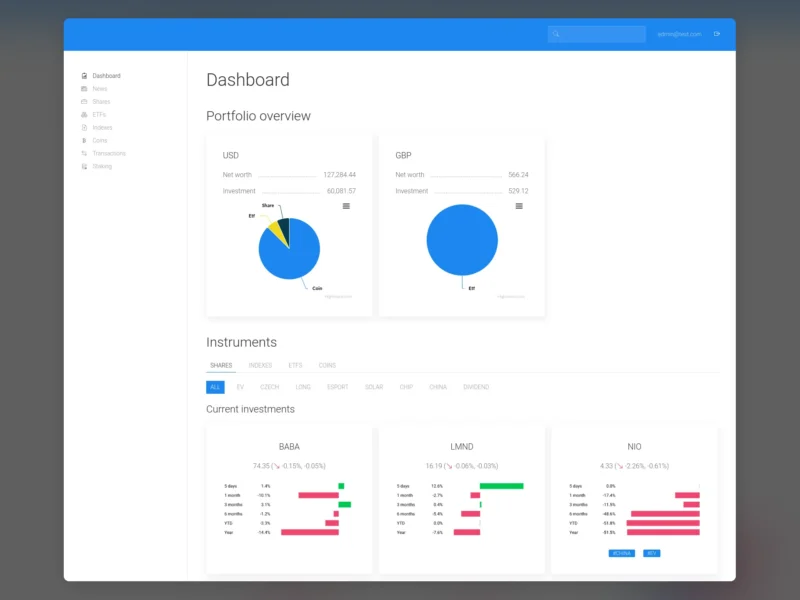
Richy is a self-hosted portfolio manager for people who hold their own investments and want the numbers in one place. It keeps a transactional ledger of shares, ETFs, market indexes and cryptocurrencies, then builds the performance, drawdown and allocation views on top of that ledger instead of asking you to type in a balance. Everything runs on your own server: a Django application with PostgreSQL and Redis, shipped as a Docker image with workers and a scheduler alongside it.
The ledger
Every holding starts as a transaction: a buy, a sell, a deposit or a withdrawal, recorded against an item — a share, an ETF, an index or a coin — with price, quantity, fee and exchange. Dividend transactions are first-class and can reference the transaction tree they belong to, so a dividend on a partly sold position is recalculated for the branches rather than smeared across the whole holding. A sell can point at the purchase it closes, which is what makes the per-transaction profit figures mean anything.
Dashboard and allocation
The dashboard opens on a portfolio overview split by currency: net worth and invested amount for each, with a pie chart of where the money sits across shares, ETFs, indexes, coins and cash. Below it sits a row of the instruments you hold, each with its price and performance bars for three days, one week, one month, six months, one year and five years — green above the purchase, red below — so a stale winner and a fresh loss are visible in the same glance.
Charts, statistics and The Eye
An item page carries the historical price chart, a performance table, and drawdown and all-time-high statistics with their own chart, plus a year high/low meter. The Eye is an intraday candlestick view with a market-range meter: five-minute intervals over the past day for shares, ETFs and indexes, thirty-minute intervals over the past 24 hours for coins, refreshed every five minutes. Transaction graphs are rendered per transaction by a scheduled task, and a separate three-month historical-data view puts recent prices next to the position you actually hold.
News
A news module fetches market news for shares, ETFs, indexes and coins from RSS feeds, stores it against the items you follow, and prunes old entries on a schedule. Feed URLs, a blacklist and the prune threshold are configuration rather than code, so a noisy source can be dropped without touching the application.
Crypto staking
Staking positions are kept apart from the ledger: the locked-up coin amount, the period it is locked for, the exchange it sits on and the reward it earns, optionally linked to the transaction that bought the coins, with open and closed lists kept separate.
What it is not
It is not a broker. There is no trading, no order routing, no advice and no attempt to predict prices — the project describes itself as a passive manager that aggregates information so you can form your own view. Prices and news come from public market sources through the project’s own Rug and Karpet libraries, so when a source changes shape a fetch can break until that library is patched; those fixes ship under the nightly image tag, and the app has not introduced breaking schema changes so far.
Running it
The published image is n1cz/richy on Docker Hub, run from the compose file in the repository: the application container, a Celery worker pool for price scraping and chart regeneration, a beat scheduler, Redis, PostgreSQL and an nginx front end, with the skeleton compose, env and nginx files supplied. At minimum BASE_URL, DOMAIN and TZ have to be set. A predefined administrator is loaded from fixtures, Django Admin sits under /admin/ for users, exchanges, items, transactions and the site menu, and the ledger lives in the database plus a mounted media directory, so the containers can be replaced without losing it.
Alternatives
- Ghostfolio — self-hosted portfolio tracker with a web UI and multi-account support