Bigcapital
- Platform
- Web Docker
- Licence
- AGPL-3.0 Open source
- Website
- bigcapital.app
- Source code
- github.com/bigcapitalhq/bigcapital
What Bigcapital is
Bigcapital is a self-hosted accounting and inventory system for small and medium businesses – the job QuickBooks, Xero and Wave sell as a subscription, run on your own server instead. It is developed by Bigcapital (Abouolia) in TypeScript on a NestJS backend and React front end, published on GitHub under the AGPL-3.0 licence, and deployed with Docker Compose against a relational database.
The project’s pitch is automation over data entry: the modules share one ledger, so an invoice, a bill or an inventory movement posts to the accounts directly and the reports stay current instead of being assembled at year end.
The bookkeeping modules
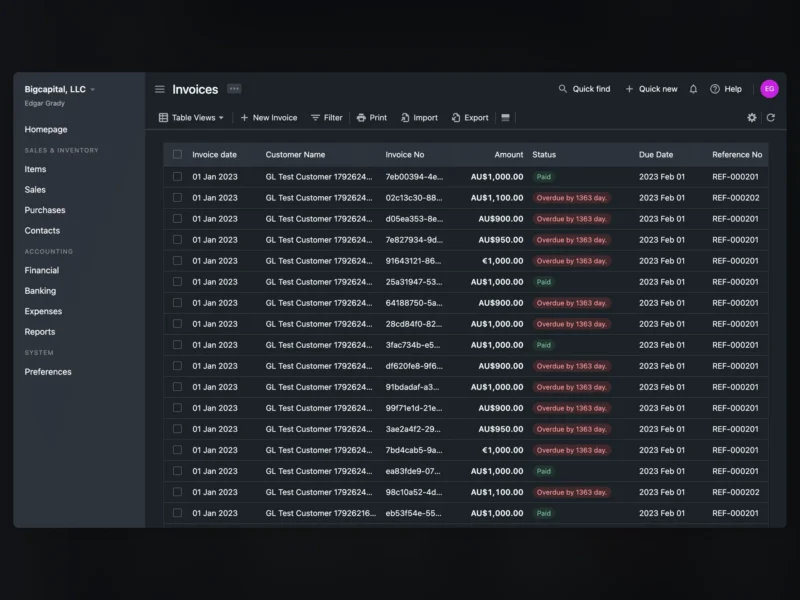
- Sales and purchases. Customisable sales invoices and bills, with items, taxes and multi-currency amounts, and contact records shared across both sides.
- Chart of accounts. A structured account tree that the rest of the app posts into, with journal entries available when a transaction needs to be recorded by hand.
- Inventory. Item and stock tracking tied to purchase and sale transactions rather than kept in a separate spreadsheet.
- Expenses. Expense recording and categorisation alongside the invoices.
- Banking. Bank feeds syncing and reconciliation against the ledger entries, so imported statement lines are matched instead of retyped.
- Multi-currency. Transactions in more than one currency, with the reporting currency applied to the statements.
Reports and access
The reporting side covers the standard statements – balance sheet, profit and loss, cash flow, general ledger, accounts receivable and accounts payable – with a comparative column against a previous period and a customise dialog for the layout. Both accrual and cash accounting bases are supported, and access is role-based: an accountant or bookkeeper can be invited to a branch without being given the whole company. Multiple branches let one install carry several entities or locations.
Running it yourself
Bigcapital is distributed as Docker images, with the web app published to Docker Hub and the deployment documented as a Docker Compose stack; the repository also carries a local development setup for anyone who wants to work on the code. A managed cloud version is announced as coming soon, and until it launches self-hosting with Docker is the supported route – which is also the reason to consider it: the AGPL licence means the code stays open and the data stays in a database you control. Google sign-in is available as an optional integration.
Where it fits
For a small business that wants proper double-entry books without a per-user subscription, Bigcapital is the closest open-source answer to QuickBooks or Xero. If you only need invoicing, Invoice Ninja is lighter; for personal rather than business finances, Firefly III is built around budgeting; Akaunting is the other general-purpose small-business option; and GnuCash remains the desktop route with local files instead of a server.