Pulsarr
- Platform
- Docker Linux Windows macOS Web
- Licence
- AGPL-3.0 Open source
- Website
- jamcalli.github.io/Pulsarr/
- Source code
- github.com/jamcalli/Pulsarr
Overview
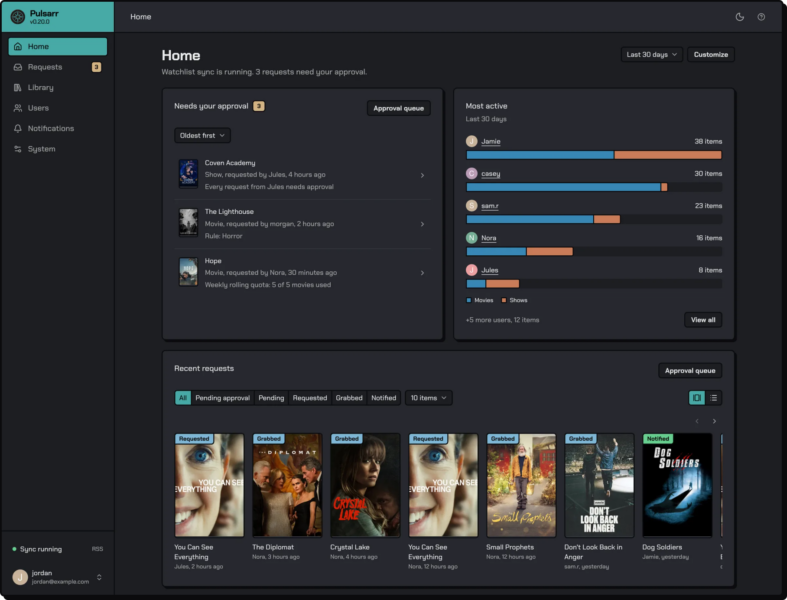
Pulsarr turns Plex watchlists into Sonarr and Radarr requests. It watches the watchlist of the Plex account that owns your server — and, if you want, those of your Plex friends — sends new titles to the right Sonarr or Radarr instance, and tells the person who added the title when it has arrived. Requests happen inside the Plex app, which means nobody has to create an account on another site just to ask for a film.
The constraint is worth knowing before you install it: Pulsarr works through Plex friendship, so it can only read the watchlists of accounts that are friends of the server’s owner, and each friend has to have their watchlist visible to friends in their Plex privacy settings — a private watchlist simply looks empty. Within that model it covers the parts of a shared media library that usually end up as a spreadsheet and a group chat: who asked for what, whether it needs approval, how much each person is allowed to request, and what should be deleted once nobody wants it any more.
Key Features
- Watchlist sync: new items are picked up within seconds with Plex Pass, or roughly every five minutes without it.
- Multi-user by design: friends’ watchlists are synced too, with per-user approval, notification and quota settings.
- Predicate content routing: a rule builder with nested all/any/not groups covering genres, user, Plex list, year, language, certification, streaming services, IMDb rating and votes, RT critic and audience scores, TMDB rating, season, series status and film status. Each route picks the target instance, root folder, quality profile, monitoring and tags — or skips the title — and can require approval or bypass quotas. One request can fan out to several instances.
- Multiple Sonarr and Radarr instances: connect as many as you run and copy content between them.
- Approvals and quotas: hold requests for a decision and cap how much each user can ask for, from the web UI or Discord.
- Delete sync: remove content once nobody has it on a watchlist any more, by watchlist or by tag, with playlist protection.
- Exclusions: block titles from ever being requested, for one user or for everyone.
- Session monitoring: grow rolling shows in Sonarr as people watch them.
- User tags and Plex labels: mark content in Sonarr, Radarr and Plex by whose watchlist it came from.
- Notifications: a Discord bot, Discord channels, Plex mobile push, webhooks, and anything Apprise can reach.
- Full REST API: everything the UI does is available programmatically, with API keys and interactive docs at
/api/docs.
Why Use Pulsarr
A shared Plex server quickly accumulates requests from people who do not use Radarr or Sonarr themselves, and the usual workaround is somebody else’s watchlist turned into manual work. Pulsarr connects the two ends: users express what they want in the app they already have, the automation decides whether it is allowed and where it belongs, and everyone is told what happened. The predicate rules and quotas are what make that safe on a server with more than a couple of users — you can allow a friend’s watchlist in general while requiring approval for horror, or capping each user at five films a week, without writing a single automation by hand.
Typical Uses
- Letting a family or a group of friends request films and shows straight from Plex without giving them access to Radarr or Sonarr.
- Routing requests automatically — 4K to one Radarr, animation to another root folder, everything else to the default profile.
- Holding requests for approval and capping per-user quotas so one person cannot fill the disk.
- Notifying users by Discord or Plex push when their request is available.
- Cleaning up titles nobody has on a watchlist any more, while protecting the playlists you care about.
- Growing rolling shows in Sonarr automatically as people watch episodes.
Getting Started
Pulsarr ships as a container — lakker/pulsarr:latest on Docker Hub, also published as ghcr.io/jamcalli/pulsarr. A minimal Compose service publishes port 3003, mounts ./data at /app/data and sets PUID/PGID; the only required first-run setting is the time zone in .env. Open http://your-server:3003 and connect Plex and your Arr instances with their API keys. Native installers for Linux, Windows and macOS exist, and PostgreSQL is supported as an alternative to the default database. The current release is v1.1.0. Documentation, including the Plex privacy setting that makes friends’ watchlists readable, is at jamcalli.github.io/Pulsarr.
Pulsarr is licensed under the GNU Affero General Public License v3.0; the full text is in the repository’s LICENSE file. A paid hosted option is offered by a third party (ElfHosted); it does not affect the self-hosted software.